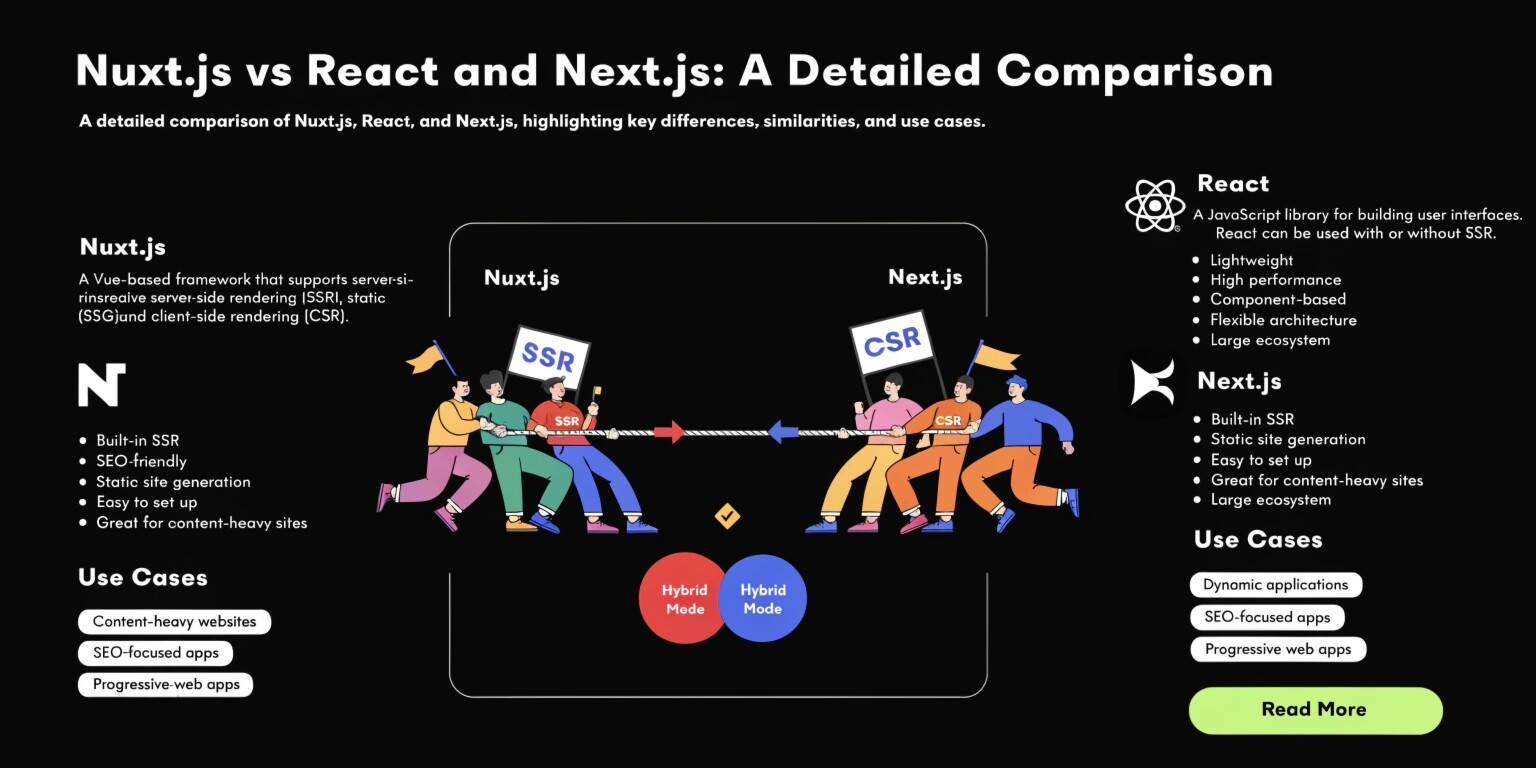
Modern web development offers developers numerous frameworks and libraries to build fast, scalable, and user-friendly applications. Among the most popular choices are React, Next.js, and Nuxt.js. While all three technologies help developers create modern web applications, they differ significantly in architecture, features, learning curve, and performance optimization.
Choosing the right framework can directly impact development speed, scalability, maintainability, and user experience. Understanding the strengths and limitations of each option is essential for making informed decisions.
In this article, we compare Nuxt.js, React, and Next.js across various aspects to help businesses and developers select the most suitable technology for their projects.
Understanding the Technologies
Before comparing them, it's important to understand what each technology offers.
React
React is a JavaScript library developed by Meta for building user interfaces.
Key characteristics include:
- Component-based architecture
- Virtual DOM rendering
- Large ecosystem
- Flexible project structure
- Extensive community support
React focuses primarily on the user interface layer and requires additional libraries for routing, state management, and server-side rendering.
Next.js
Next.js is a React-based framework developed to simplify application development.
It extends React by providing:
- Server-Side Rendering (SSR)
- Static Site Generation (SSG)
- API routes
- Built-in routing
- SEO optimization
- Performance enhancements
Next.js eliminates much of the configuration complexity associated with React applications.
Nuxt.js
Nuxt.js is a framework built on top of Vue.js.
It offers:
- Server-Side Rendering
- Static Site Generation
- Automatic routing
- SEO-friendly architecture
- File-based structure
- Improved developer productivity
Nuxt.js aims to provide a complete development environment for Vue developers.
Learning Curve
React
React is relatively easy to learn for developers familiar with JavaScript.
However, building production-ready applications often requires additional knowledge of:
- Routing libraries
- State management tools
- Build configurations
- Third-party integrations
This can increase complexity for beginners.
Next.js
Developers already familiar with React can quickly adopt Next.js.
The framework simplifies many tasks and reduces configuration requirements.
Learning difficulty:
- Moderate
Nuxt.js
Nuxt.js is often considered beginner-friendly due to Vue's intuitive syntax and structured framework design.
Learning difficulty:
- Easy to Moderate
For developers new to modern frontend frameworks, Nuxt.js may provide a smoother learning experience.
Performance Comparison
Performance is a critical factor in modern web applications.
React
React applications typically rely on Client-Side Rendering (CSR).
While effective, CSR may result in:
- Slower initial page loads
- Reduced SEO effectiveness
- Increased client-side processing
Next.js
Next.js offers:
- SSR
- SSG
- Incremental Static Regeneration (ISR)
These features significantly improve performance and page loading speed.
Nuxt.js
Nuxt.js also supports:
- SSR
- SSG
- Hybrid rendering
Performance is generally comparable to Next.js for many applications.
Both Nuxt.js and Next.js outperform traditional client-rendered React applications in SEO-sensitive environments.
SEO Capabilities
Search engine optimization remains essential for content-driven websites.
React
SEO implementation often requires additional configuration and tools.
Challenges include:
- Delayed content rendering
- Limited crawler visibility
Next.js
Built-in SSR and SSG make Next.js highly SEO-friendly.
Benefits include:
- Faster indexing
- Improved search rankings
- Better Core Web Vitals
Nuxt.js
Nuxt.js offers similar SEO advantages through server-side rendering and metadata management.
For SEO-focused projects, both Nuxt.js and Next.js are excellent choices.
Developer Experience
Developer productivity significantly affects project success.
React
Advantages:
- Flexibility
- Massive ecosystem
- Large community support
Challenges:
- More setup required
- Architecture decisions left to developers
Next.js
Advantages:
- Convention-based structure
- Integrated tooling
- Simplified deployment
Developers spend less time configuring infrastructure and more time building features.
Nuxt.js
Advantages:
- Clear project organization
- Automatic routing
- Simple configuration
Many developers appreciate Nuxt's streamlined workflow and consistency.
Scalability
As applications grow, scalability becomes increasingly important.
React
React scales effectively but often requires architectural planning and additional tooling.
Next.js
Designed for large-scale production applications.
Supports:
- Enterprise deployments
- API integrations
- Large content platforms
- E-commerce applications
Nuxt.js
Nuxt also supports enterprise-grade applications and scales efficiently with proper architecture.
Both frameworks provide strong scalability options.
Ecosystem and Community
React
React has the largest ecosystem among the three technologies.
Benefits include:
- Extensive documentation
- Thousands of libraries
- Strong corporate backing
Next.js
Benefits from React's ecosystem while offering additional framework-specific resources.
Its popularity continues to grow rapidly.
Nuxt.js
Although smaller than React's ecosystem, Nuxt enjoys strong support from the Vue community and offers numerous plugins and modules.
Best Use Cases
When to Choose React
Choose React if:
- Maximum flexibility is required
- Building highly customized applications
- Existing React expertise is available
When to Choose Next.js
Choose Next.js if:
- SEO is important
- Performance is a priority
- Building content-heavy platforms
- Developing enterprise applications
When to Choose Nuxt.js
Choose Nuxt.js if:
- Working within the Vue ecosystem
- Seeking simplicity and productivity
- Building SEO-focused applications
- Prioritizing developer experience
Future Outlook
All three technologies continue to evolve rapidly.
Key trends include:
- Server components
- Edge rendering
- AI-powered development
- Improved performance optimization
- Enhanced developer tooling
Next.js currently leads many enterprise web projects, while Nuxt.js continues to gain popularity among Vue developers. React remains one of the most influential frontend technologies worldwide.
Conclusion
Nuxt.js, React, and Next.js each offer unique advantages. React provides unmatched flexibility and ecosystem support, Next.js delivers exceptional performance and SEO capabilities, and Nuxt.js combines simplicity with powerful features for Vue developers.
The best choice ultimately depends on project requirements, team expertise, scalability goals, and business objectives. By carefully evaluating these factors, organizations can select a framework that supports long-term success and delivers outstanding user experiences.