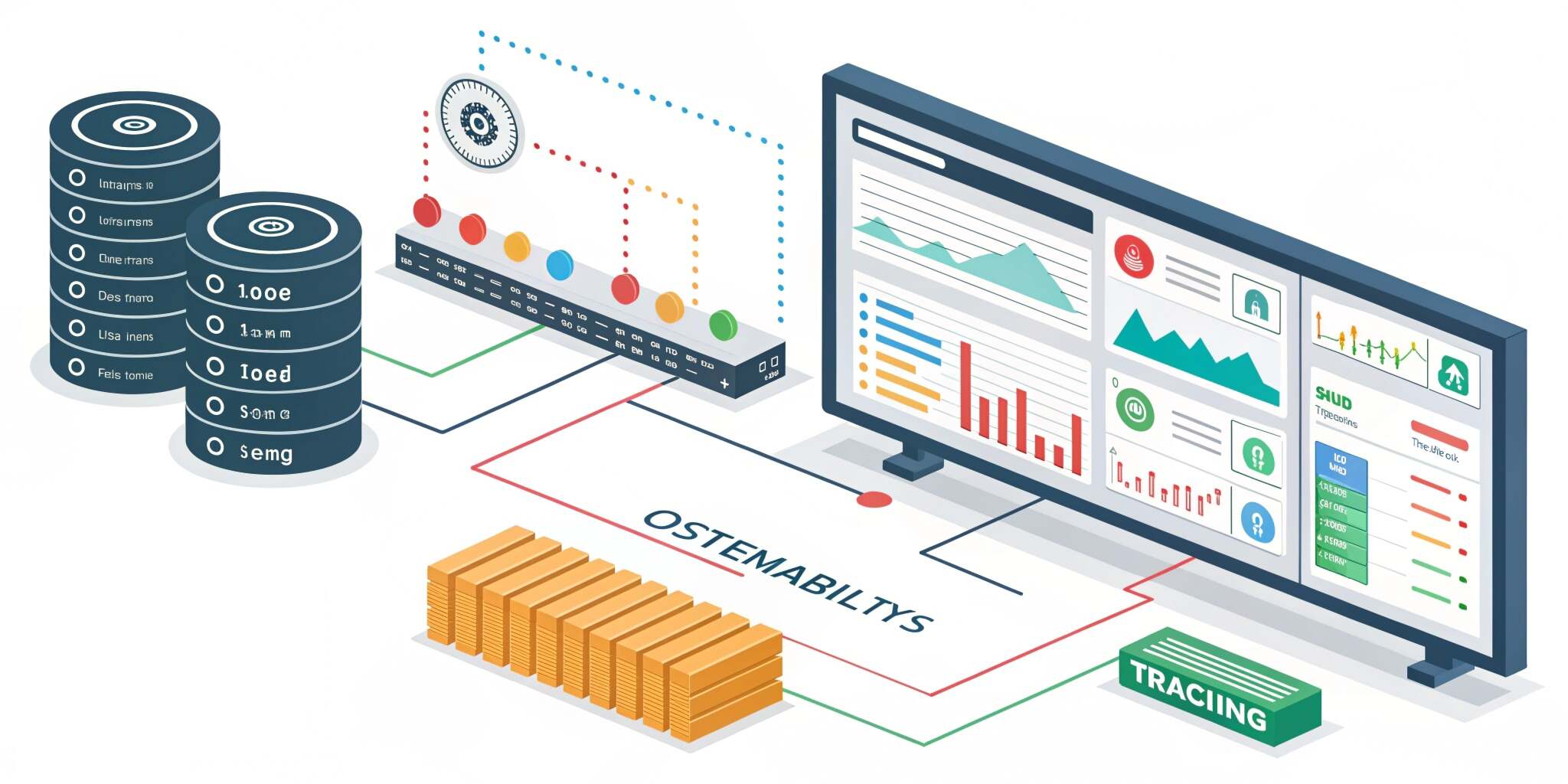
As web applications evolve into highly distributed, cloud-native systems, understanding how they behave in production becomes increasingly difficult. Traditional monitoring answers what is broken, but it often fails to explain why. This gap has led to the rise of observability, a discipline focused on gaining deep visibility into system behavior through logs, metrics, and tracing.
What Is Observability?
Observability refers to the ability to understand a system’s internal state based on the data it produces. Unlike basic monitoring, observability allows engineers to investigate unknown or unexpected issues by exploring rich, contextual signals emitted by applications and infrastructure.
In modern web systems—especially microservices-based architectures—observability is not optional. It is foundational for reliability, performance, and rapid incident response.
The Three Pillars of Observability
Observability is built on three core data signals: logs, metrics, and traces. Each serves a distinct purpose, and together they provide a complete picture of system health.
1. Logs: Detailed Event Records
Logs are time-stamped records of discrete events that occur within a system. They provide granular context about what happened at a specific moment.
Key Characteristics of Logs:
- High-cardinality, unstructured or semi-structured data
- Useful for debugging errors and edge cases
- Capture application-level context
At scale, logs must be centralized and searchable. Without proper indexing and retention strategies, logs quickly become overwhelming rather than useful.
2. Metrics: Quantitative System Signals
Metrics are numerical measurements collected over time, representing system performance and health.
Common examples include:
- Request latency
- Error rates
- CPU and memory usage
- Throughput
Metrics are ideal for dashboards and alerting because they provide a high-level overview of system behavior. However, they lack detailed context, making them insufficient on their own for root-cause analysis.
3. Tracing: End-to-End Request Visibility
Tracing tracks the journey of a request as it flows through multiple services. In distributed systems, this is critical for understanding performance bottlenecks and failures.
Distributed tracing provides:
- Visibility into service dependencies
- Latency breakdowns across components
- Identification of slow or failing services
Traces connect logs and metrics by providing context across system boundaries.
Why Observability Matters in Modern Web Applications
Modern web systems are dynamic and unpredictable. Containers scale up and down, services are deployed frequently, and traffic patterns change rapidly.
Observability enables teams to:
- Detect issues before users are impacted
- Reduce mean time to resolution (MTTR)
- Understand performance degradation
- Make data-driven architectural decisions
Without observability, teams operate reactively, relying on guesswork and manual investigation.
Observability vs Traditional Monitoring
Monitoring focuses on predefined conditions and known failure modes. Observability, on the other hand, enables exploration of unknown problems.
MonitoringObservabilityReactiveProactiveFixed alertsExploratory analysisLimited contextRich system insights
Both are important, but observability provides the depth needed for complex systems.
Implementing Observability at Scale
Successful observability implementations follow best practices:
- Instrumentation First: Applications must emit meaningful logs, metrics, and traces
- Correlation: Use trace IDs to link logs and metrics
- Centralization: Aggregate observability data across services
- Sampling: Balance data volume and cost
- Actionable Alerts: Alert on symptoms, not noise
Tools such as OpenTelemetry have standardized observability instrumentation across platforms.
Common Observability Challenges
- Data overload and high costs
- Poor signal-to-noise ratio
- Lack of standardization across teams
- Missing context in logs and traces
These challenges require thoughtful design rather than simply adding more tools.
Final Thoughts
Observability is a cornerstone of modern web engineering. Logs, metrics, and tracing work together to provide deep insight into system behavior, enabling teams to build reliable, scalable, and high-performing applications. As systems grow in complexity, observability becomes not just a technical capability, but a strategic advantage.