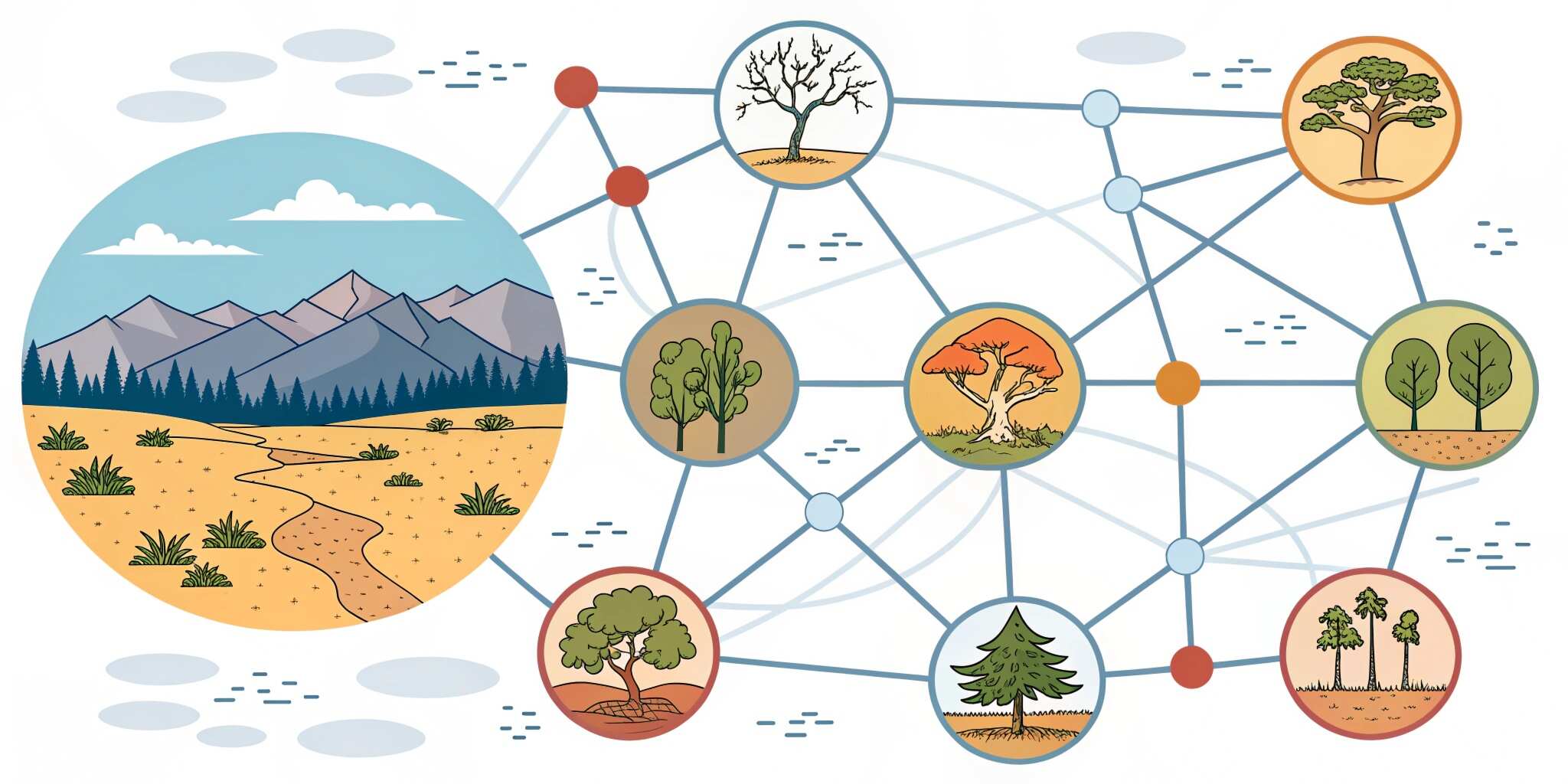
Procedural world generation has grown from simple Perlin noise heightmaps into highly sophisticated, multi-layered ecosystem simulations. Yet modern open-world games still struggle with one critical challenge: biome coherence. Traditional generators can scatter deserts next to snowfields, generate forests on cliffs, or ignore temperature gradients entirely.
To address this, developers are increasingly leveraging Graph-Neural Networks (GNNs)—a deep-learning architecture designed specifically to work with graph-structured data. Since biomes behave like interconnected systems rather than independent patches, GNNs are a natural fit for modeling environmental relationships at scale.
Why GNNs Are Ideal for Biome Generation
Biomes are shaped by relationships:
- Temperature affects vegetation
- Altitude affects climate
- Water flow influences erosion
- Neighboring biomes blend gradually
- Ecosystems propagate based on local and non-local influences
These are complex graph-like interactions, where each map region can be represented as a node connected to its neighbors. GNNs excel at learning patterns from such structures.
Where noise-based methods rely on randomness and thresholds, GNNs learn rules of nature, such as:
- “Grasslands typically exist between deserts and forests.”
- “Cold biomes form at high altitudes.”
- “Rivers originate from peaks and flow into lowlands.”
This leads to believable, non-chaotic biome layouts.
How GNN-Based Biome Generation Works
1. World Grid → Graph Conversion
The map is divided into cells (chunks or hex-tiles).
Each cell becomes a node with features like:
- Height
- Temperature
- Moisture
- Soil richness
- Sun exposure
- Slope angle
- Water proximity
Edges connect adjacent nodes, forming a graph.
2. GNN Training on Real-World Biome Data
Developers train GNNs using:
- NASA climate data
- Highlands vs coastal ecosystems
- Real vegetation distribution
- Geological erosion maps
The GNN learns how nature organically organizes biomes.
3. Biome Prediction Layer
The GNN predicts the best biome for each node by considering both local and surrounding constraints:
- Desert → if low moisture + high heat + far from rivers
- Tundra → if cold + moderate altitude
- Swamp → if low elevation + high moisture
- Conifer forest → if cold + moderate elevation
Because GNNs propagate information across the graph, transitions become smooth and natural.
4. Ecosystem Simulation Using GNN Rollouts
Instead of generating static worlds, GNNs allow world evolution over time.
Examples:
- Forests gradually expand around water sources.
- Drought reduces vegetation density.
- Snowline shifts with climate cycles.
The world becomes alive rather than merely generated.
Advantages Over Classical Procedural Systems
✔ Natural Transitions
Biomes blend instead of clashing, reducing visual inconsistency.
✔ Climate-Coherent Worlds
Temperature, altitude, and moisture produce scientifically believable ecosystems.
✔ Dynamic Evolution
Worlds evolve like real ecosystems rather than remaining static.
✔ Scalability to Planet-Sized Worlds
GNNs handle millions of nodes using GPU batching.
✔ Gameplay Integration
Developers can link:
- Resource spawning
- Wildlife migration
- Weather cycles
- Survival mechanics
to biome simulation outputs.
Use Cases in Games
- Survival Games: Forest density changes with player activity or fires.
- RPGs: Ecosystem changes influence quest availability or enemy spawns.
- Space Colonization Games: New planets receive autogenerated ecosystems using GNN models.
- Voxel Games: Chunk-based biomes generated with graph reasoning instead of noise.
Future of GNN-Driven Biomes
Next-generation engines may combine:
- NeRFs for 3D terrain detail
- LLMs for narrative-driven world evolution
- GNNs for climate & ecosystem simulation
This creates persistent, living environments where story and ecology are interconnected.
Imagine a world where your actions cause forests to retreat, civilizations to relocate based on resource scarcity, or weather patterns to shift based on dynamic climate simulation. GNN-driven biomes are one of the most exciting leaps toward such fully reactive ecosystems.