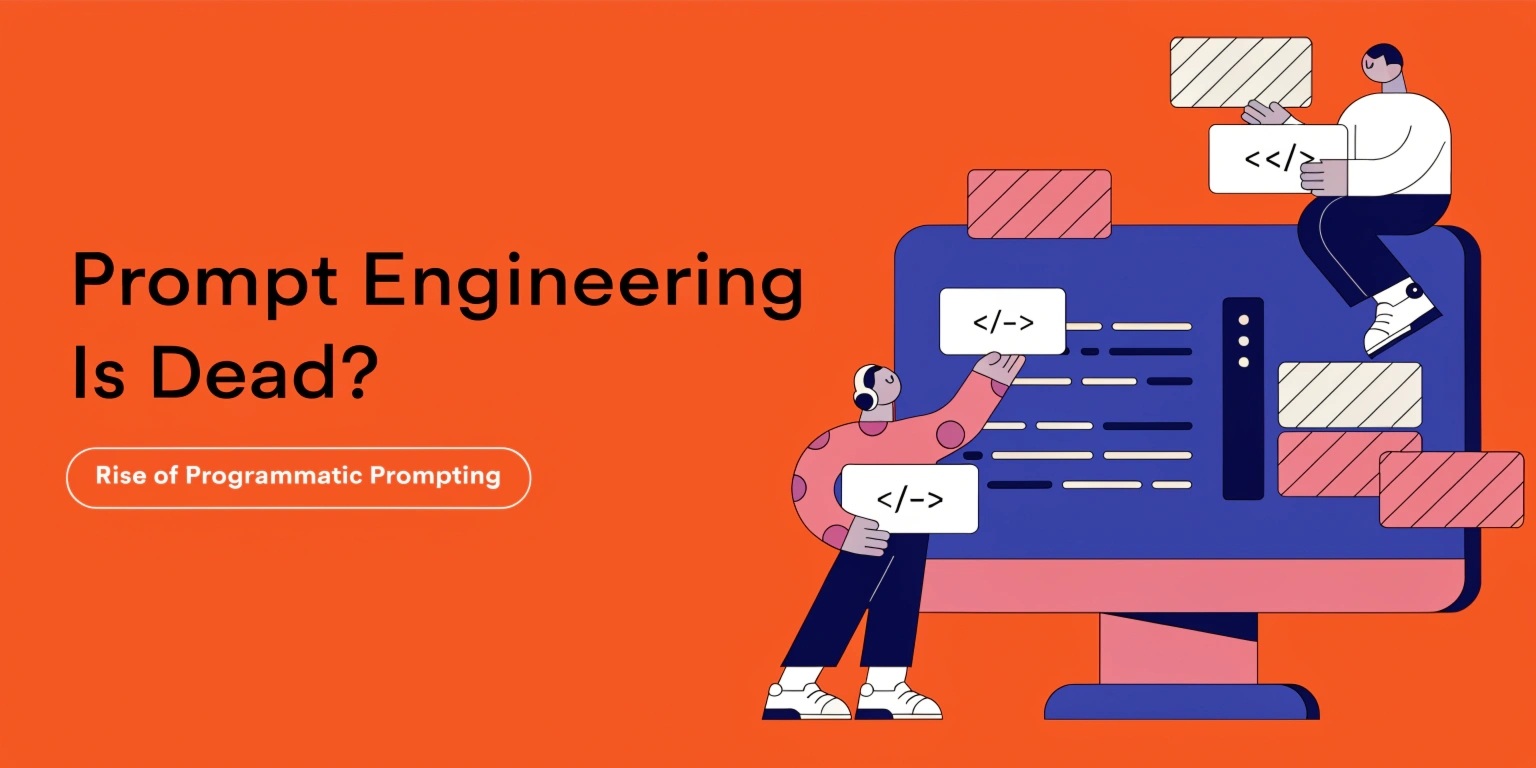
For the past few years, prompt engineering has been one of the most discussed skills in the artificial intelligence industry. Developers, marketers, researchers, and businesses focused heavily on crafting the “perfect prompt” to get better outputs from large language models (LLMs).
However, the AI landscape is evolving rapidly. As AI systems become more sophisticated, static prompts are no longer enough for building scalable and production-ready applications. A new paradigm is emerging—programmatic prompting.
Many experts now argue that traditional prompt engineering is slowly becoming outdated. The future of AI development is shifting toward dynamic, automated, and context-aware prompting systems that can adapt intelligently in real time.
So, is prompt engineering really dead? Not exactly. But its role is changing dramatically.
What is Prompt Engineering?
Prompt engineering refers to the process of designing instructions or input queries to guide AI models toward producing desired outputs.
Examples include:
- Writing detailed chatbot instructions
- Structuring AI-generated content requests
- Creating coding prompts
- Designing image generation prompts
- Optimizing AI responses with formatting rules
Early AI adoption heavily relied on manually crafted prompts because model behavior depended significantly on wording and context.
Simple modifications in phrasing could produce dramatically different results.
The Limitations of Traditional Prompt Engineering
Although prompt engineering helped unlock the power of generative AI, it introduced several limitations when applied at scale.
1. Static Prompts Are Hard to Scale
Manually writing prompts works for small experiments, but large AI systems require thousands of dynamic interactions.
Static prompts struggle with:
- Changing user context
- Personalized responses
- Real-time data integration
- Multi-step reasoning
- Complex workflows
As applications grow, maintaining large prompt libraries becomes difficult and inefficient.
2. Lack of Consistency
Traditional prompting often produces inconsistent outputs because AI models may interpret prompts differently across sessions.
This creates challenges for:
- Enterprise automation
- Customer support systems
- AI-powered workflows
- Business-critical applications
Organizations need predictable and repeatable outputs, which static prompts alone cannot guarantee.
3. Difficulty Managing Complex AI Systems
Modern AI applications involve:
- Multiple AI models
- External APIs
- Databases
- Memory systems
- Tool integrations
- Decision engines
Single prompts cannot effectively manage these advanced architectures.
This is where programmatic prompting becomes essential.
What is Programmatic Prompting?
Programmatic prompting refers to generating, modifying, and orchestrating prompts dynamically through code, logic, and automated workflows.
Instead of writing one fixed prompt manually, developers build systems that:
- Assemble prompts dynamically
- Inject contextual information
- Retrieve external knowledge
- Chain multiple prompts together
- Validate outputs automatically
- Adapt prompts based on user behavior
In simple terms, prompts become part of software architecture rather than standalone text instructions.
Why Programmatic Prompting Is Rising
1. AI Applications Are Becoming More Complex
Modern AI systems are no longer simple chatbots. They are evolving into intelligent agents capable of performing multi-step tasks.
Examples include:
- AI coding assistants
- Autonomous research tools
- Customer support automation
- AI workflow orchestration
- Enterprise copilots
These systems require adaptive prompting logic rather than static text.
2. Retrieval-Augmented Generation (RAG)
One major advancement driving programmatic prompting is Retrieval-Augmented Generation (RAG).
RAG systems dynamically retrieve external information before generating responses.
This means prompts are automatically enriched with:
- Database content
- Company knowledge bases
- Live documents
- Search results
- User history
The prompt becomes programmatically generated based on context and relevance.
3. AI Agents and Tool Usage
Modern AI agents can now:
- Call APIs
- Execute functions
- Use external tools
- Analyze files
- Browse data
- Make decisions
Frameworks like OpenAI integrations, LangChain, and LlamaIndex enable developers to create advanced prompt pipelines programmatically.
Instead of manually writing every prompt, developers create orchestration systems that generate prompts automatically based on task requirements.
4. Better Reliability and Automation
Programmatic prompting improves:
- Output consistency
- Scalability
- Error handling
- Workflow automation
- Personalization
- AI governance
This makes it far more suitable for enterprise-grade AI applications.
Core Components of Programmatic Prompting
Dynamic Context Injection
The system automatically inserts relevant context into prompts based on:
- User data
- Session history
- External knowledge
- Real-time information
Prompt Chaining
Complex tasks are divided into multiple smaller prompts executed sequentially.
For example:
- Retrieve information
- Summarize content
- Generate insights
- Format final response
Output Validation
AI responses can be checked automatically for:
- Accuracy
- Structure
- Safety
- Formatting
- Business rules
Memory Systems
AI systems can retain context across interactions, enabling more personalized and intelligent conversations.
Is Prompt Engineering Completely Dead?
No. Prompt engineering is still important, but its role is evolving.
Instead of focusing only on clever wording tricks, modern AI developers now need:
- System design skills
- Workflow orchestration
- API integration knowledge
- Context management
- AI evaluation strategies
Prompt engineering is becoming a subset of larger AI engineering practices.
The future belongs to developers who understand how to combine prompts with:
- Data pipelines
- Software infrastructure
- Automation systems
- AI agent frameworks
The Future of AI Development
As AI ecosystems mature, programmatic prompting will likely become standard practice across industries.
Future AI systems will increasingly rely on:
- Autonomous AI agents
- Context-aware orchestration
- Real-time memory systems
- Multimodal AI pipelines
- Self-improving prompt architectures
This shift mirrors the evolution of traditional software engineering. Early web development relied heavily on manual scripting, but modern applications now use scalable frameworks and automated systems.
AI development is following a similar path.
Conclusion
Prompt engineering is not disappearing, but it is evolving beyond manual prompt writing. Programmatic prompting represents the next stage of AI system design, where prompts become dynamic, intelligent, and deeply integrated into software architecture.
As businesses demand scalable, reliable, and automated AI solutions, developers must move beyond static prompts and embrace orchestration-driven AI workflows.
The future of generative AI will not depend solely on writing better prompts—it will depend on building smarter systems that can generate, manage, and optimize prompts automatically.