Introduction
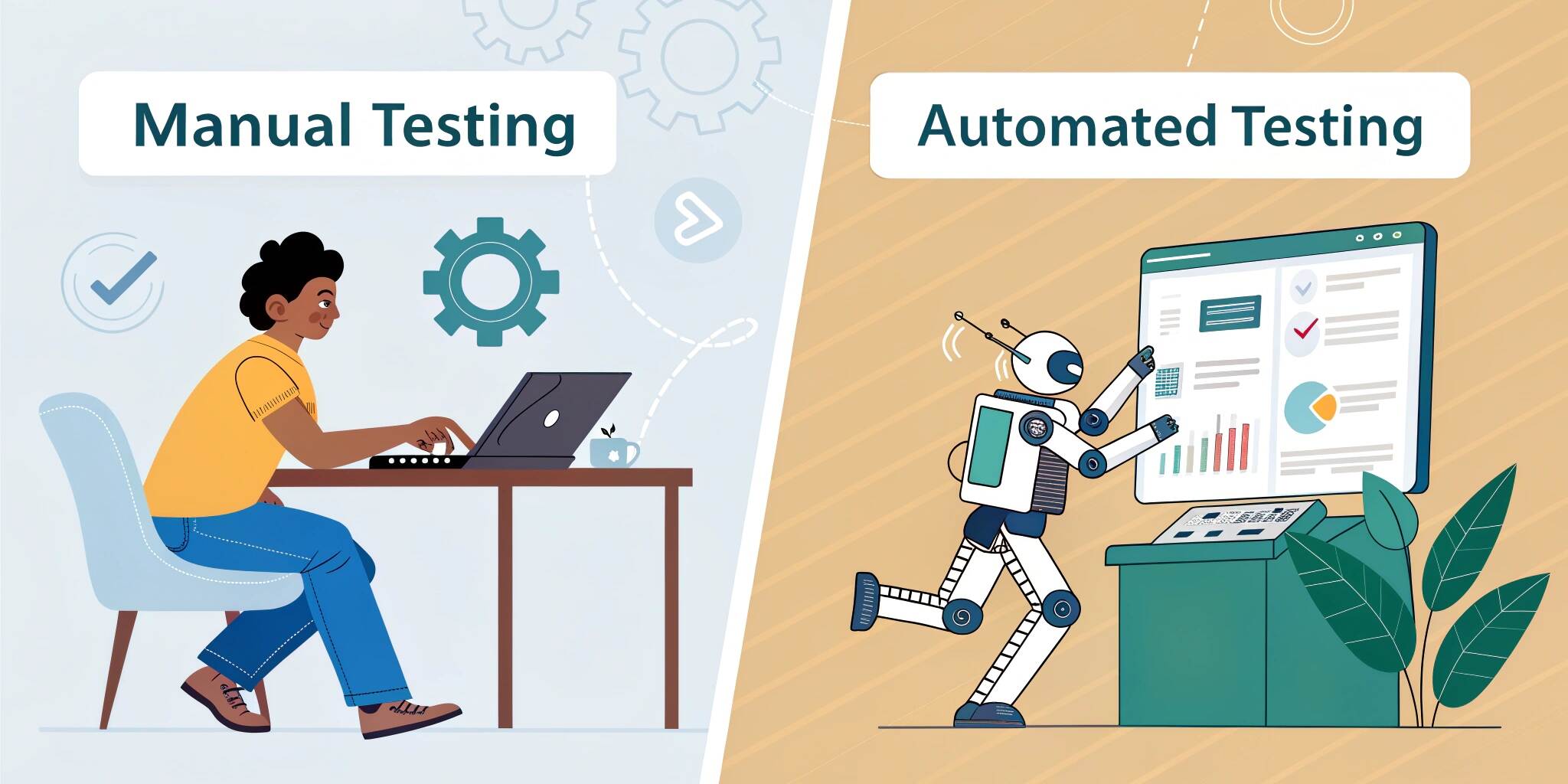
In today’s fast-paced software development world, testing plays a vital role in ensuring product quality. While manual testing focuses on human-driven validation, automated testing leverages scripts and tools to accelerate the process. Python has emerged as one of the most preferred languages for automation due to its simplicity, versatility, and rich ecosystem of testing libraries.
This guide explores Python’s role in manual vs. automated testing, their differences, and how QA teams can integrate Python effectively.
1. Manual Testing Overview
Manual testing involves executing test cases without automation tools. Testers follow predefined steps to verify software behavior, identify bugs, and ensure usability.
When Manual Testing Works Best:
- Early-stage product testing
- Exploratory testing
- Usability and user experience checks
- Short-term, low-complexity projects
Limitations:
- Time-consuming
- Prone to human error
- Limited scalability
2. Automated Testing Overview
Automated testing uses scripts and tools to run tests repeatedly without manual intervention. Python, with frameworks like PyTest, unittest, and Selenium, makes automation efficient and adaptable.
When Automated Testing Works Best:
- Large-scale regression testing
- Continuous Integration/Continuous Deployment (CI/CD) pipelines
- Performance and load testing
- Long-term projects requiring frequent releases
Advantages of Python in Automated Testing:
- Easy-to-learn syntax
- Large library support (Selenium, PyTest, Behave, Robot Framework)
- Strong community support
- Cross-platform compatibility
3. Python in Manual Testing
While Python is mainly associated with automation, it can still aid manual testers:
- Data Processing – Use Python scripts to handle large datasets for test input.
- Log Analysis – Quickly parse and analyze system logs.
- Report Generation – Automate test reports even for manually executed cases.
4. Python in Automated Testing
Python excels in automation with:
- Web Testing – Selenium WebDriver for browser automation.
- API Testing – Requests & PyTest for REST API validation.
- Performance Testing – Locust for load simulation.
- BDD – Behave for behavior-driven development.
Example PyTest snippet:
python
CopyEdit
import pytest
def test_addition():
assert 2 + 3 == 5
5. Manual vs. Automated Testing with Python – Key Differences
FactorManual TestingAutomated Testing with PythonSpeedSlower, human-drivenFaster, script-drivenAccuracyCan be prone to human errorHigh precision, consistent resultsCostLower short-term costHigher setup cost, lower long-term costScalabilityLimitedHighly scalableMaintenanceLess setup, but repetitive workRequires script updates, less manual work
6. Best Practices for Using Python in Testing
- Start with clear test case design.
- Use virtual environments to manage dependencies.
- Follow POM (Page Object Model) for maintainable Selenium tests.
- Integrate with CI/CD tools like Jenkins or GitHub Actions.
- Keep scripts modular and reusable.
Conclusion
Python is a game-changer for QA teams, enabling them to bridge the gap between manual and automated testing. While manual testing remains essential for exploratory and usability assessments, Python-powered automation ensures faster delivery, higher accuracy, and better scalability.
By strategically combining both approaches, teams can achieve optimal testing efficiency and product quality.