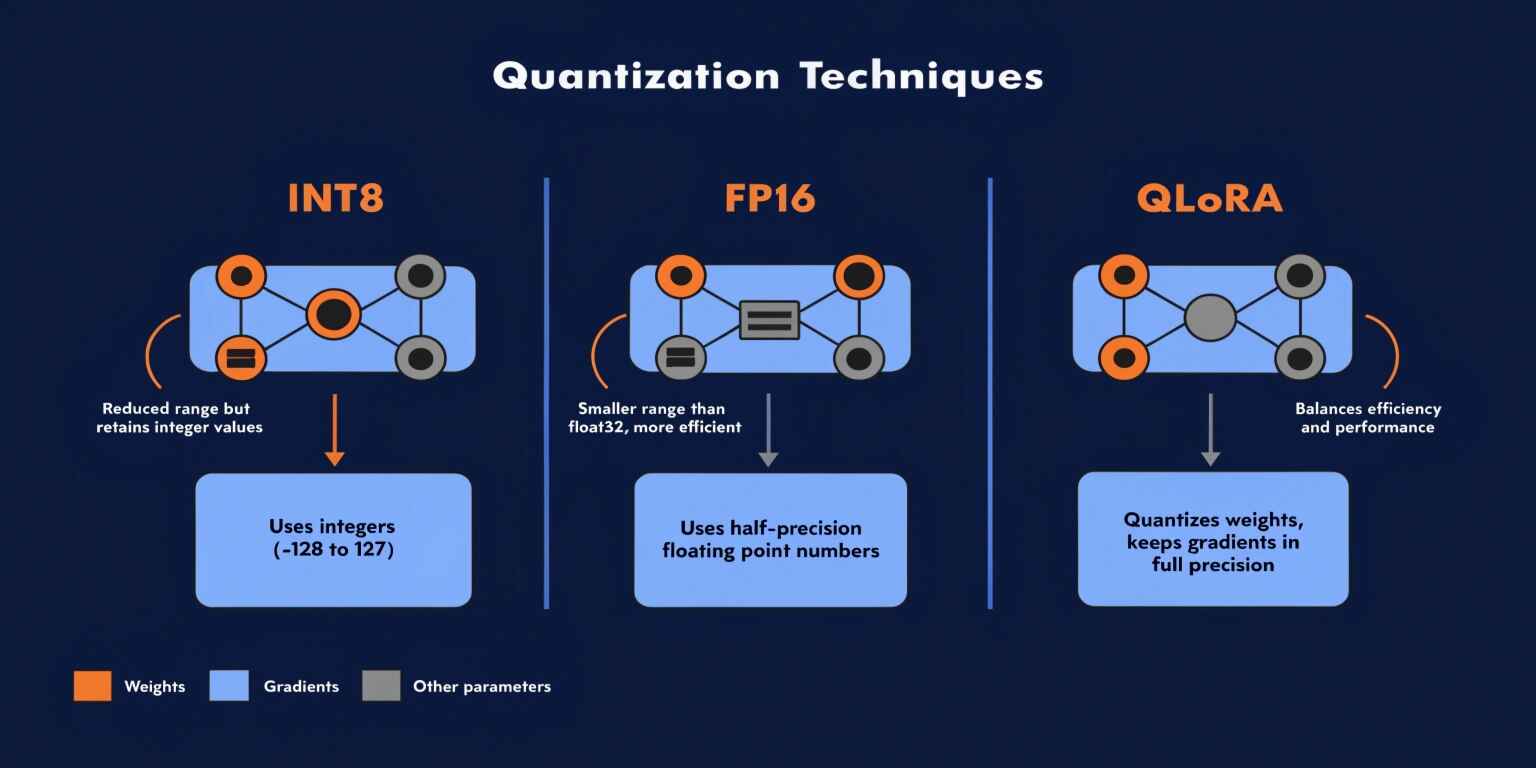
As artificial intelligence models continue growing in size and complexity, optimizing performance and reducing computational costs have become major challenges for developers and organizations. Modern deep learning models, especially large language models (LLMs), often require massive GPU memory, high processing power, and expensive infrastructure to train and deploy efficiently.
This is where quantization techniques play a critical role.
Quantization is a machine learning optimization method that reduces the numerical precision used to represent model weights and computations. By lowering precision, AI systems can:
- Reduce memory usage
- Improve inference speed
- Lower hardware requirements
- Enable edge deployment
- Decrease operational costs
Techniques such as INT8, FP16, and QLoRA have become increasingly important in modern AI engineering, particularly for large-scale transformer models and cloud-based inference systems.
Quantization is now considered a key component of scalable and cost-efficient AI deployment.
What is Quantization in Machine Learning?
Quantization is the process of converting high-precision numerical values into lower-precision formats while preserving acceptable model accuracy.
Traditional deep learning models often use:
- 32-bit floating point numbers (FP32)
However, FP32 computations require significant:
- Memory bandwidth
- GPU resources
- Storage capacity
Quantization reduces these requirements by using lower-precision representations such as:
- FP16 (16-bit floating point)
- INT8 (8-bit integers)
- 4-bit quantization systems
This dramatically improves computational efficiency.
Why Quantization Matters
Modern AI models contain billions of parameters.
For example:
- Large language models
- Image generation systems
- Recommendation engines
- Speech recognition systems
Running these models in FP32 precision can be extremely resource-intensive.
Quantization helps organizations:
- Deploy AI on smaller hardware
- Improve inference latency
- Scale AI applications economically
- Run models on edge devices
- Reduce energy consumption
Without optimization techniques like quantization, many AI systems would remain too expensive for practical production use.
Understanding Floating Point Precision
Floating point numbers are widely used in machine learning because they can represent very large and very small values accurately.
Different precision levels include:
FP32>FP16>INT8>INT4FP32 > FP16 > INT8 > INT4FP32>FP16>INT8>INT4
Higher precision:
- Improves numerical accuracy
- Increases computational cost
Lower precision:
- Reduces memory usage
- Accelerates processing
- May slightly reduce accuracy
The goal is finding the best balance between efficiency and model performance.
FP16 Quantization
FP16 (16-bit floating point) reduces numerical precision from 32 bits to 16 bits.
This approach became highly popular because modern GPUs are optimized for half-precision computation.
Benefits of FP16 include:
- Reduced GPU memory usage
- Faster training and inference
- Improved throughput
- Lower infrastructure costs
FP16 is commonly used in:
- Deep learning training
- Transformer inference
- Computer vision systems
- Generative AI applications
Companies such as NVIDIA heavily optimize hardware acceleration for FP16 workloads.
Challenges of FP16
Although FP16 improves efficiency, it can introduce:
- Numerical instability
- Gradient underflow
- Precision loss in sensitive computations
To solve these issues, many systems use mixed precision training, where:
- Some operations remain in FP32
- Others run in FP16
This balances stability and performance effectively.
INT8 Quantization
INT8 quantization converts model weights and computations into 8-bit integer representations.
Compared to FP32:
- Memory usage decreases significantly
- Inference becomes much faster
- Hardware utilization improves
INT8 is especially useful for:
- Production inference
- Mobile AI deployment
- Edge computing
- Real-time AI applications
INT8 inference is widely adopted in:
- Recommendation systems
- Autonomous systems
- AI-powered mobile applications
Benefits of INT8 Quantization
Smaller Model Size
Models become dramatically smaller and easier to deploy.
Faster Inference
Integer operations are computationally cheaper than floating point calculations.
Lower Power Consumption
INT8 systems require less energy, making them suitable for edge devices.
Better Scalability
Cloud infrastructure costs can be reduced significantly.
Challenges of INT8 Quantization
Lower precision may reduce model accuracy, particularly in:
- Sensitive neural network layers
- Large transformer architectures
- Complex reasoning systems
Quantization-aware training is often used to reduce accuracy degradation during optimization.
QLoRA: Quantized Low-Rank Adaptation
QLoRA is one of the most important recent advancements in efficient large language model fine-tuning.
QLoRA combines:
- Low-bit quantization
- LoRA (Low-Rank Adaptation)
- Efficient parameter tuning
This technique allows developers to fine-tune extremely large AI models using significantly less GPU memory.
QLoRA became especially popular for open-source LLM customization.
How QLoRA Works
Instead of retraining all model parameters:
- The base model is quantized to lower precision
- Small trainable adapter layers are added
- Only the adapters are updated during fine-tuning
This dramatically reduces:
- GPU memory requirements
- Training costs
- Infrastructure complexity
QLoRA enables efficient fine-tuning even on consumer-grade GPUs.
Why QLoRA is Important
Traditional LLM fine-tuning can require:
- Multiple high-end GPUs
- Massive cloud infrastructure
- Very large memory capacity
QLoRA reduces these requirements substantially while maintaining strong model performance.
This has accelerated:
- Open-source AI development
- Research accessibility
- Enterprise AI customization
- Personalized AI assistants
Organizations can now fine-tune advanced models without extremely expensive hardware setups.
Quantization in Large Language Models
Modern LLM deployment depends heavily on quantization.
Popular AI systems often use:
- FP16 for training
- INT8 for inference
- 4-bit quantization for memory optimization
Quantization allows organizations to deploy AI models at scale while managing operational costs effectively.
Companies such as Meta and OpenAI actively research efficient inference and model optimization strategies.
Quantization for Edge AI
Edge AI systems operate on:
- Smartphones
- IoT devices
- Embedded systems
- Autonomous hardware
These devices have limited:
- Memory
- Compute power
- Energy capacity
Quantization enables AI deployment in resource-constrained environments while maintaining acceptable performance.
Challenges in Quantized AI Systems
Despite major benefits, quantization introduces several technical challenges.
Accuracy Trade-Offs
Lower precision can reduce model accuracy.
Hardware Compatibility
Not all hardware platforms support advanced quantization efficiently.
Calibration Complexity
Quantized models require careful calibration and optimization.
Debugging Difficulty
Low-precision numerical behavior can become difficult to analyze.
Future of AI Quantization
Quantization research is evolving rapidly.
Future advancements may include:
- Adaptive precision systems
- Dynamic quantization
- AI-specific hardware accelerators
- Automated quantization pipelines
- Ultra-low-bit neural networks
Efficient AI deployment will become increasingly important as model sizes continue growing.
Conclusion
Quantization techniques such as INT8, FP16, and QLoRA are transforming modern artificial intelligence by making large-scale machine learning systems more efficient, scalable, and affordable. These optimization methods reduce memory usage, improve inference speed, lower infrastructure costs, and enable deployment across cloud and edge environments.
As AI models continue becoming larger and more computationally demanding, quantization will remain a critical technology for sustainable and accessible AI development. Organizations that effectively adopt quantization strategies will gain significant advantages in performance, scalability, and operational efficiency.