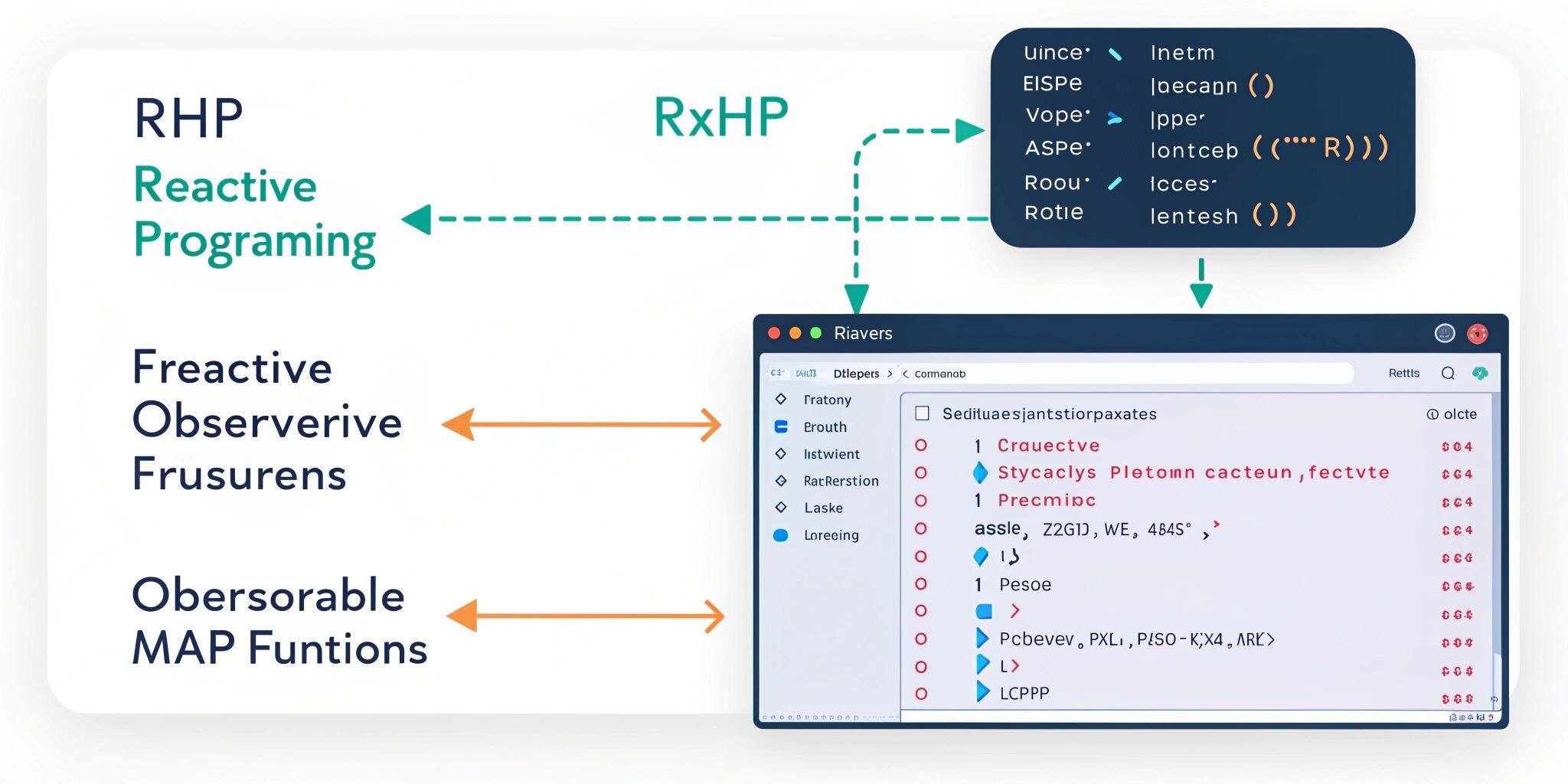
PHP has long been a dominant language for web development, but traditionally it has been seen as synchronous and blocking in nature. With the rise of high-performance, real-time, and scalable applications, developers need ways to handle asynchronous data streams efficiently. This is where Reactive Programming comes in. Using RxPHP (Reactive Extensions for PHP), developers can adopt a reactive, event-driven approach that makes applications more responsive, scalable, and easier to maintain.
What is Reactive Programming?
Reactive Programming is a paradigm focused on asynchronous data streams and the propagation of change. Instead of handling events one by one in a blocking manner, Reactive Programming allows developers to represent data as continuous streams that can be observed, transformed, and managed over time.
In simpler terms, it shifts programming from a request/response model to a stream-based model where applications can react to events in real time.
Why RxPHP?
RxPHP is the PHP implementation of ReactiveX, a set of libraries available in multiple languages (such as Java, JavaScript, and Python). It enables developers to use observables, operators, and schedulers to manage asynchronous data in a structured way.
Key benefits of RxPHP include:
- Non-blocking execution: Improves performance by preventing application slowdown during heavy operations.
- Better scalability: Handles thousands of concurrent events without crashing.
- Cleaner code: Offers operators that simplify complex event-handling logic.
- Cross-platform consistency: Follows the same principles as other ReactiveX implementations, making it easier for multi-language teams.
Core Concepts of RxPHP
To fully leverage RxPHP, developers need to understand its core building blocks:
- Observable – Represents a stream of data that can be subscribed to. For example, a stream of user inputs, database queries, or API responses.
- Observer – A consumer that listens to the observable and reacts to emitted data.
- Operators – Functions used to transform, filter, or combine streams. Examples include map, filter, and merge.
- Schedulers – Control concurrency, determining when and how data streams are processed.
Use Cases of RxPHP in Real Applications
RxPHP opens the door to a variety of real-world applications in PHP:
- Real-time applications: Live chat systems, notifications, and dashboards.
- Data streaming: Handling large datasets or log streams efficiently.
- API aggregation: Combining multiple API responses into a single stream.
- Event-driven microservices: Enabling loosely coupled and responsive services.
- Background processing: Managing queues, tasks, and asynchronous jobs seamlessly.
Advantages of Reactive Programming with RxPHP
- High responsiveness: Applications react instantly to user actions or data changes.
- Reduced complexity: Simplifies handling multiple asynchronous events compared to traditional callbacks.
- Improved resource utilization: Uses non-blocking I/O, which consumes fewer server resources.
- Future-proofing PHP: Keeps PHP relevant in modern, real-time web development trends.
Challenges and Considerations
While RxPHP offers powerful features, it also comes with challenges:
- Learning curve: Developers need to shift their mindset from imperative to reactive.
- Debugging complexity: Tracking streams can be harder than traditional code.
- Not suitable for all apps: Small or simple applications may not require RxPHP’s complexity.
Conclusion
Reactive Programming with RxPHP represents a significant step forward for PHP developers looking to build modern, scalable, and event-driven applications. By embracing observables, operators, and non-blocking execution, developers can create systems that are more responsive to user interactions and real-time data.
As demand for real-time web applications grows, RxPHP is becoming an essential tool in the PHP ecosystem, enabling developers to keep pace with the evolving landscape of software development.