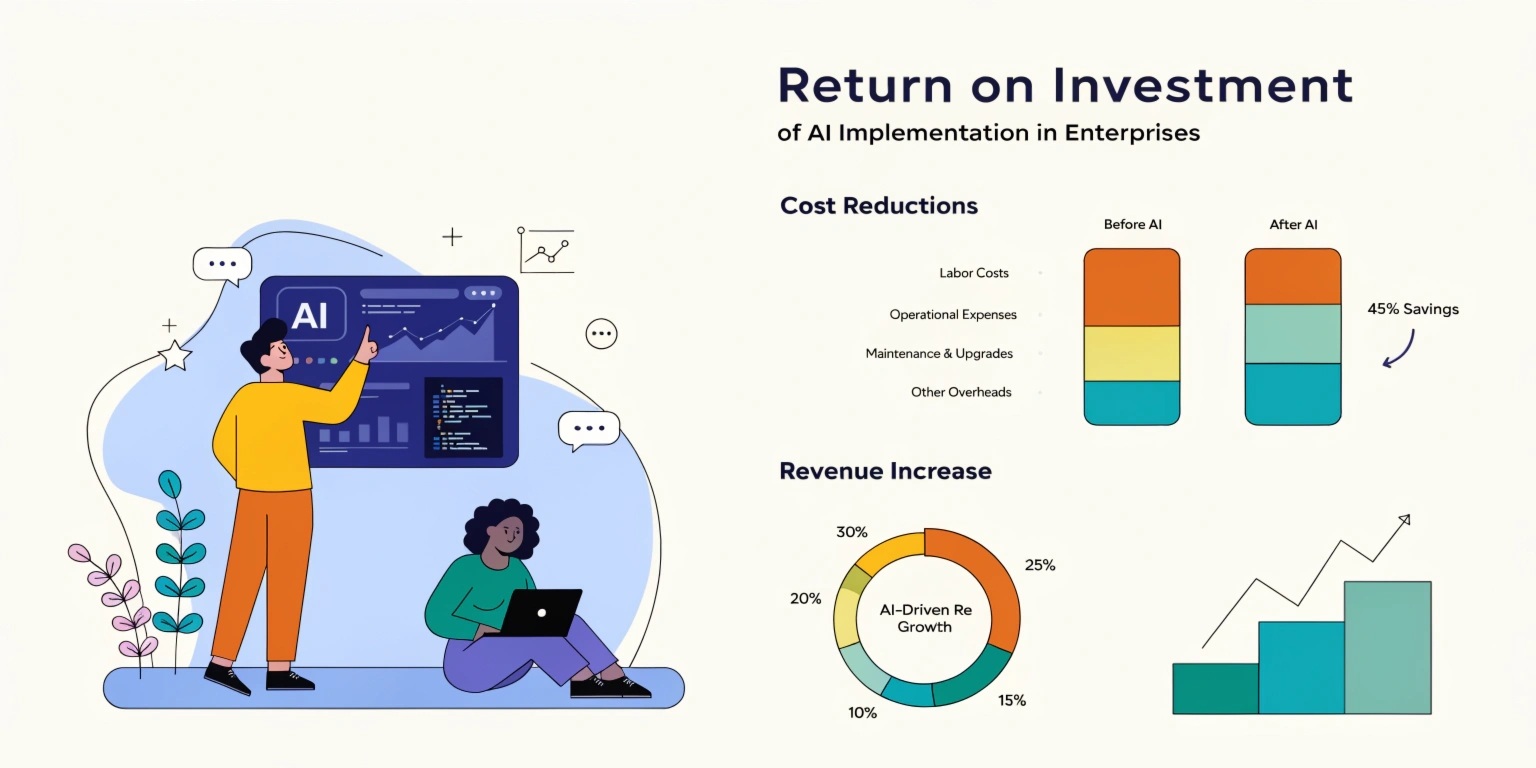
Artificial intelligence has rapidly evolved from an experimental technology into a core business strategy for enterprises worldwide. Organizations across industries are investing heavily in AI-powered systems to automate operations, improve decision-making, optimize customer experiences, and drive innovation.
However, despite growing adoption, one critical question continues to dominate boardroom discussions: What is the actual return on investment (ROI) of AI implementation?
Unlike traditional software investments, AI projects often involve complex infrastructure, large datasets, ongoing model training, and organizational transformation. Measuring the business value of AI requires more than simply tracking cost reductions.
Modern enterprises now evaluate AI ROI through operational efficiency, productivity improvements, customer engagement, scalability, and long-term strategic advantages.
What Does ROI of AI Mean?
ROI of AI refers to the measurable business value generated from investments in artificial intelligence technologies compared to the total implementation cost.
AI ROI can include:
- Increased operational efficiency
- Revenue growth
- Reduced labor costs
- Improved customer retention
- Faster decision-making
- Reduced human error
- Enhanced forecasting accuracy
The challenge is that AI benefits are often both direct and indirect, making measurement more complex than traditional IT investments.
Why Enterprises Are Investing in AI
Businesses adopt AI to solve large-scale operational and strategic challenges.
Common enterprise AI use cases include:
- Customer service automation
- Predictive analytics
- Fraud detection
- Supply chain optimization
- Personalized marketing
- AI-powered search
- Intelligent process automation
- Recommendation systems
Companies like Microsoft, Google, and IBM have accelerated enterprise AI adoption by offering scalable AI infrastructure and cloud-based machine learning platforms.
Organizations are increasingly recognizing AI as a long-term competitive advantage rather than a short-term experiment.
Key Areas Where AI Generates ROI
1. Operational Efficiency
One of the biggest drivers of AI ROI is automation.
AI systems can automate repetitive tasks such as:
- Data entry
- Invoice processing
- Customer support queries
- Document analysis
- Workflow approvals
This reduces manual effort and allows employees to focus on higher-value tasks.
For example:
- AI chatbots can handle thousands of customer requests simultaneously
- Automated systems reduce processing times dramatically
- AI-powered workflows improve operational speed and consistency
The result is lower operational costs and increased productivity.
2. Improved Decision-Making
AI excels at analyzing massive amounts of data quickly and accurately.
Enterprises use AI-driven analytics for:
- Demand forecasting
- Risk assessment
- Financial predictions
- Customer behavior analysis
- Inventory optimization
Better decisions lead to:
- Reduced business risks
- Improved resource allocation
- Faster strategic planning
Predictive analytics can significantly improve business performance across departments.
3. Enhanced Customer Experience
Customer experience has become a major differentiator in competitive markets.
AI improves customer engagement through:
- Personalized recommendations
- Intelligent chatbots
- AI-powered search
- Automated customer support
- Sentiment analysis
Businesses that deliver personalized experiences often see:
- Higher customer retention
- Increased conversion rates
- Improved customer satisfaction
AI enables enterprises to provide faster and more relevant customer interactions at scale.
4. Revenue Growth Opportunities
AI not only reduces costs but also creates new revenue opportunities.
Examples include:
- Personalized product recommendations
- Dynamic pricing systems
- AI-powered sales forecasting
- Cross-selling optimization
- Automated lead scoring
AI-driven insights help businesses identify hidden growth opportunities and improve sales performance.
5. Risk Reduction and Fraud Detection
In industries such as finance and cybersecurity, AI plays a critical role in risk management.
AI systems can:
- Detect fraud patterns
- Monitor suspicious activity
- Identify security threats
- Analyze anomalies in real time
This helps enterprises avoid financial losses and improve compliance management.
Challenges in Measuring AI ROI
Although AI offers significant advantages, measuring ROI can be difficult due to several factors.
Long-Term Value Realization
Some AI benefits emerge gradually over time.
For example:
- Improved customer loyalty
- Enhanced operational maturity
- Better strategic insights
These outcomes may not produce immediate financial returns but create long-term business value.
Data Quality Issues
AI performance depends heavily on data quality.
Poor data can lead to:
- Inaccurate predictions
- Inefficient automation
- Reduced business impact
Enterprises often underestimate the cost and complexity of preparing high-quality data.
High Initial Investment
AI implementation may require:
- Cloud infrastructure
- Skilled AI engineers
- Data scientists
- Model training resources
- Integration with existing systems
Initial investments can be substantial, especially for large enterprises.
Organizational Resistance
Employees may resist AI adoption due to:
- Fear of automation
- Lack of technical understanding
- Workflow disruptions
Successful AI implementation requires change management and employee training.
Best Practices for Maximizing AI ROI
Start with High-Impact Use Cases
Organizations should focus first on areas where AI can deliver measurable improvements quickly.
Examples include:
- Customer support automation
- Sales forecasting
- Process optimization
Quick wins help build organizational confidence.
Define Clear KPIs
Enterprises should establish measurable goals before implementation.
Common AI KPIs include:
- Cost reduction percentage
- Revenue growth
- Productivity improvements
- Customer satisfaction scores
- Process completion time
Clear metrics make ROI evaluation more accurate.
Invest in Data Infrastructure
Reliable AI systems require strong data pipelines and governance frameworks.
Good data management improves:
- Model accuracy
- Scalability
- Security
- Compliance
Combine Human Expertise with AI
AI performs best when combined with human decision-making.
Human oversight helps:
- Validate AI outputs
- Improve ethical compliance
- Handle complex business scenarios
AI should enhance human capabilities rather than fully replace them.
The Future of Enterprise AI ROI
As AI technologies mature, enterprises are moving beyond simple automation toward intelligent business ecosystems.
Future AI trends include:
- Autonomous AI agents
- Generative AI copilots
- AI-driven enterprise workflows
- Real-time predictive operations
- Hyper-personalization
The ROI of AI will increasingly come from:
- Strategic agility
- Innovation acceleration
- Competitive differentiation
- Intelligent automation at scale
Organizations that integrate AI deeply into business operations will gain long-term advantages in efficiency, scalability, and market adaptability.
Conclusion
The ROI of AI implementation in enterprises extends far beyond cost reduction. AI is transforming how organizations operate, make decisions, serve customers, and innovate in competitive markets.
Although measuring AI ROI can be complex, businesses that align AI initiatives with strategic objectives can achieve significant operational and financial benefits.
Successful AI adoption requires careful planning, quality data, scalable infrastructure, and continuous optimization. Enterprises that approach AI as a long-term business transformation strategy rather than a short-term technology trend are more likely to achieve sustainable returns and future-ready growth.