As businesses grow, their web applications face an increasing challenge: handling high volumes of traffic without compromising speed or reliability. For PHP developers, ensuring scalability is critical to maintaining a seamless user experience. Scaling PHP applications requires more than just faster servers—it demands architectural optimization, smart caching, and cloud-ready solutions.
Why Scaling PHP Applications Matters
High traffic can overwhelm a poorly optimized PHP application, leading to slow response times, downtime, or even system crashes. Modern users expect fast, responsive, and reliable applications. Scaling ensures that:
- Applications can handle spikes in traffic without disruption.
- Resources are used efficiently, lowering costs.
- Performance remains consistent, boosting customer satisfaction.
Strategies for Scaling PHP Applications
Let’s explore key techniques to scale PHP applications for high-traffic environments.
1. Optimize PHP Code and Frameworks
Efficient code is the foundation of scalability. Refactor legacy code, leverage PHP 8+ features like JIT compilation, and use modern frameworks such as Laravel or Symfony that encourage best practices.
2. Implement Caching
Caching reduces server load by serving frequently requested content quickly. Options include:
- Opcode caching with OPcache.
- Data caching using Redis or Memcached.
- Full-page caching for static content.
3. Database Optimization
The database is often the bottleneck. Strategies include:
- Indexing and query optimization.
- Database replication for read-heavy workloads.
- Sharding for distributing data across multiple servers.
- Using NoSQL databases for unstructured data.
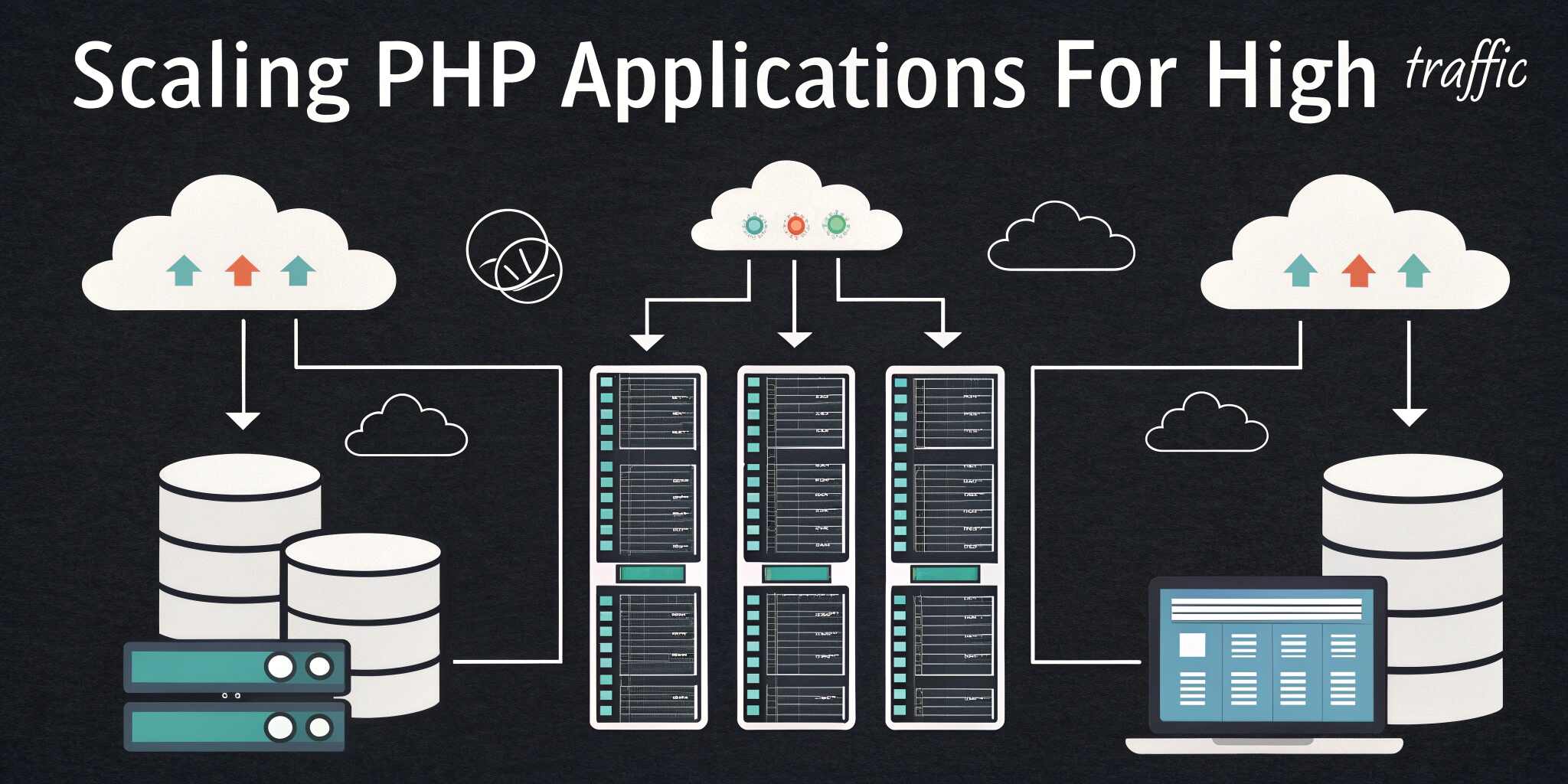
4. Load Balancing
Distribute traffic across multiple servers with load balancers like NGINX, HAProxy, or AWS ELB. This ensures no single server is overwhelmed and applications remain highly available.
5. Content Delivery Networks (CDN)
A CDN reduces latency by serving content from servers geographically closer to users. Popular options include Cloudflare, Akamai, and AWS CloudFront.
6. Asynchronous Processing
Offload long-running tasks to background workers using queues like RabbitMQ, Beanstalk, or Laravel Horizon. This keeps user-facing operations fast and responsive.
7. Horizontal and Vertical Scaling
- Vertical scaling: Adding more resources (CPU, RAM) to existing servers.
- Horizontal scaling: Adding more servers to distribute workloads.
- Horizontal scaling is preferred for long-term growth as it ensures resilience.
8. Embrace Cloud-Native Solutions
Cloud providers like AWS, Google Cloud, and Azure provide auto-scaling, serverless functions, and managed databases to handle fluctuating traffic.
9. Monitoring and Logging
Proactive monitoring with tools like New Relic, Datadog, or ELK Stack ensures you can detect performance bottlenecks before they impact users.
Challenges in Scaling PHP
While strategies exist, developers face challenges such as:
- Managing state across distributed servers.
- Handling concurrency in session-heavy applications.
- Balancing cost-effectiveness with performance.
These require thoughtful architectural decisions and sometimes re-engineering of existing systems.
The Future of Scaling PHP
As PHP continues to evolve, scalability will become easier with improvements in async capabilities, stronger frameworks, and tighter cloud integrations. The combination of PHP 8+ features, modern DevOps practices, and cloud-native architecture ensures PHP remains a powerful tool for high-traffic applications.
Conclusion
Scaling PHP applications for high traffic is not a one-time effort but an ongoing process of optimization, monitoring, and adaptation. From caching and database tuning to load balancing and cloud-native scaling, developers have a robust toolkit to ensure PHP applications remain resilient in today’s demanding digital environment.