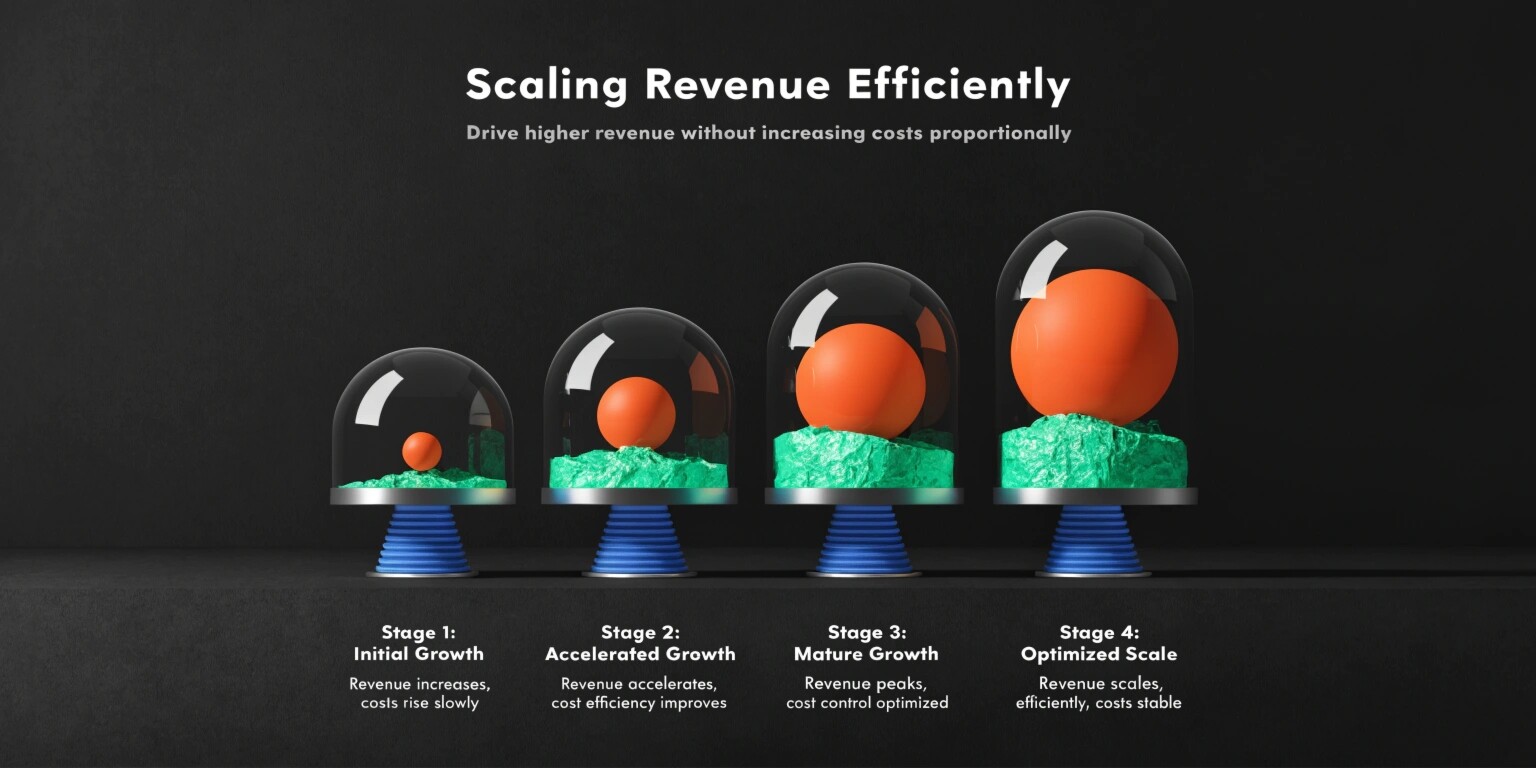
One of the biggest challenges businesses face is scaling revenue without seeing a proportional rise in costs. While growth is the goal, uncontrolled expenses can quickly eat into profits. The key lies in building a scalable business model—one that allows revenue to grow faster than operational costs.
In today’s digital-first economy, companies that leverage smart systems, automation, and strategic planning can achieve exponential growth without a matching increase in expenses.
What Does Scalable Growth Mean?
Scalable growth refers to the ability of a business to increase revenue significantly while keeping costs relatively stable. This is often achieved by optimizing processes, leveraging technology, and focusing on high-margin offerings.
A scalable business doesn’t rely heavily on manual effort or linear resource expansion. Instead, it uses systems that can handle growth efficiently.
Key Strategies to Scale Revenue Efficiently
1. Leverage Automation
Automation reduces manual work, minimizes errors, and improves efficiency. Businesses can automate:
- Customer onboarding
- Email marketing campaigns
- Sales funnels
- Customer support (chatbots)
Automation tools allow you to handle more customers without hiring additional staff, directly improving profit margins.
2. Focus on High-Margin Products or Services
Not all revenue is equal. Some products generate higher profit margins than others. By focusing on:
- Digital products (eBooks, courses, software)
- Subscription-based services
- Premium offerings
you can increase revenue without significantly increasing costs.
3. Build Scalable Digital Assets
Digital assets can generate income repeatedly with minimal additional cost. Examples include:
- Online courses
- Mobile apps
- SaaS platforms
- Content websites
Once created, these assets can serve thousands of users simultaneously without major cost increases.
4. Optimize Pricing Strategy
Strategic pricing can significantly boost revenue without increasing costs. Consider:
- Value-based pricing
- Tiered pricing models
- Upselling and cross-selling
Even a small increase in pricing can lead to substantial revenue growth if executed correctly.
5. Improve Customer Retention
Acquiring new customers is often more expensive than retaining existing ones. Focus on:
- Customer experience
- Loyalty programs
- Personalized communication
Higher retention rates lead to increased lifetime value (LTV) without additional acquisition costs.
6. Use Data-Driven Decision Making
Analytics helps identify what’s working and what’s not. By tracking:
- Customer behavior
- Conversion rates
- Marketing ROI
you can optimize strategies and eliminate wasteful spending.
7. Scale Marketing Without Increasing Spend
Instead of increasing marketing budgets, focus on efficiency:
- SEO for organic traffic
- Content marketing
- Referral programs
- Social media engagement
These channels can deliver long-term results with relatively low ongoing costs.
8. Outsource and Delegate Smartly
Rather than hiring full-time employees for every role, consider:
- Freelancers
- Agencies
- Remote teams
This reduces fixed costs and provides flexibility as your business grows.
Common Mistakes to Avoid
- Scaling too quickly without systems in place
- Ignoring operational inefficiencies
- Over-hiring instead of automating
- Focusing only on revenue, not profitability
Avoiding these mistakes ensures sustainable and profitable growth.
Real-World Example
Consider a SaaS company. Once the software is developed, the cost of serving additional users is minimal. By improving marketing and onboarding processes, the company can scale to thousands of users without significantly increasing operational costs.
This is a classic example of scalable growth—high revenue with controlled expenses.
Benefits of Scaling Revenue Efficiently
- Higher profit margins
- Better resource utilization
- Increased business valuation
- Long-term sustainability
- Competitive advantage
Conclusion
Scaling revenue without increasing costs proportionally is not just a goal—it’s a necessity for modern businesses. By leveraging automation, optimizing pricing, focusing on high-margin offerings, and improving efficiency, companies can achieve sustainable growth.
The future belongs to businesses that work smarter, not harder. By implementing these strategies, you can build a scalable model that drives revenue while keeping costs under control.