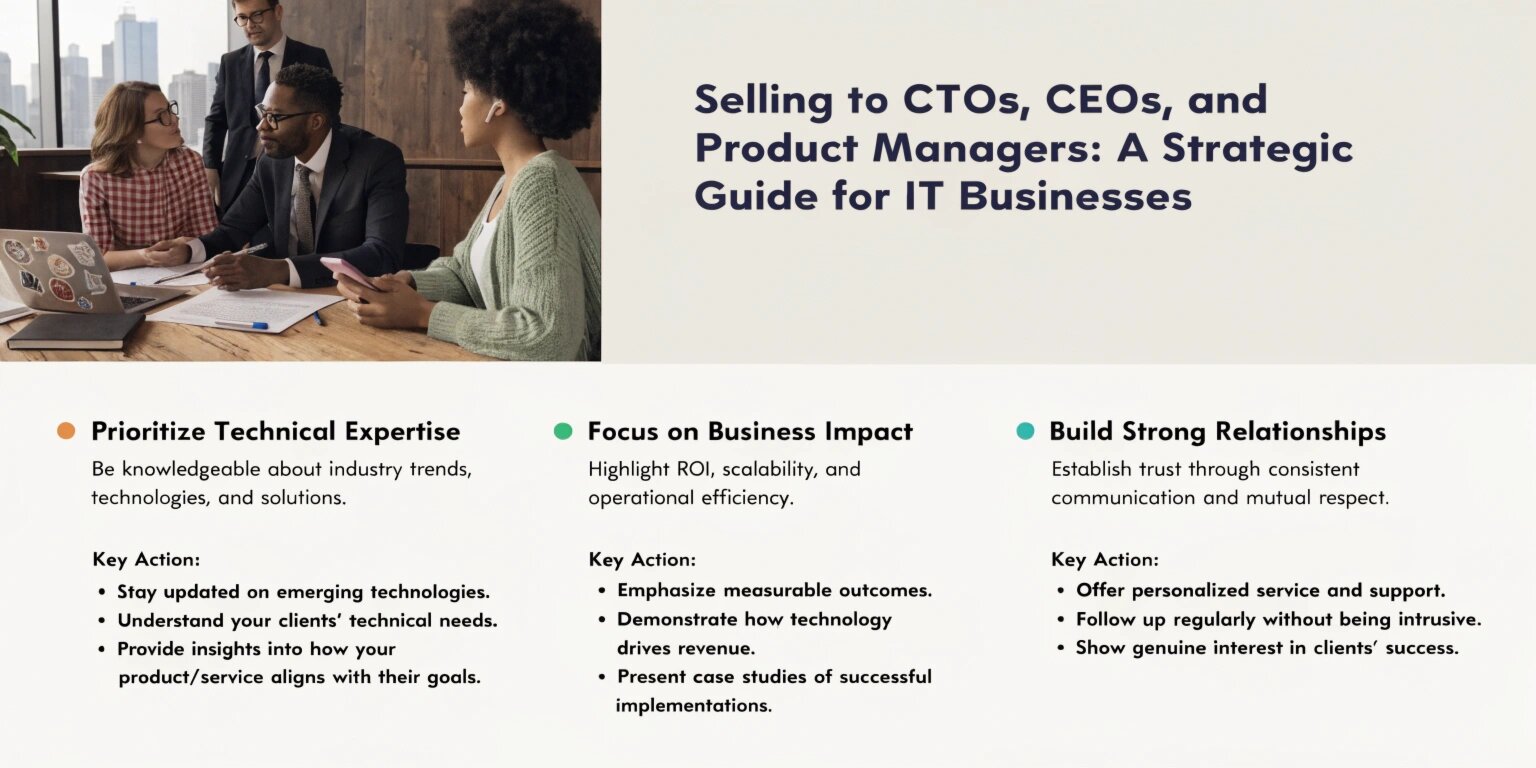
Selling to high-level decision-makers like CTOs, CEOs, and Product Managers is not just about pitching your product—it’s about understanding their mindset, aligning with their goals, and delivering measurable value. Each role has distinct priorities, and tailoring your approach can significantly increase your chances of closing deals.
Understanding the Decision-Makers
Before you sell, you must understand who you’re selling to.
CTOs (Chief Technology Officers) focus on technical scalability, architecture, security, and long-term sustainability. They care about how your solution integrates with existing systems and whether it aligns with the company’s tech roadmap.
CEOs (Chief Executive Officers) are driven by business outcomes—growth, revenue, cost efficiency, and competitive advantage. They are less concerned with technical details and more focused on ROI and strategic impact.
Product Managers act as the bridge between business and technology. They prioritize user experience, product-market fit, timelines, and feature delivery. They evaluate whether your solution helps them build better products faster.
Tailoring Your Sales Approach
A one-size-fits-all pitch rarely works in enterprise sales. You need to customize your messaging:
- For CTOs:
- Speak their language. Highlight system performance, security compliance, scalability, and integration capabilities. Provide technical documentation, case studies, and architecture diagrams. Be prepared for deep technical discussions.
- For CEOs:
- Focus on results. Show how your solution increases revenue, reduces costs, or improves efficiency. Use data, metrics, and success stories. Keep your pitch concise and outcome-driven.
- For Product Managers:
- Emphasize usability, speed of development, and customer impact. Demonstrate how your solution solves user problems and accelerates product delivery.
Build Value, Not Just Features
One of the biggest mistakes in IT sales is focusing too much on features rather than value. Decision-makers are not buying your product—they are buying solutions to their problems.
Instead of saying:
"Our platform has AI-powered analytics."
Say:
"Our platform helps you reduce decision-making time by 40% through AI-driven insights."
Always translate features into business outcomes.
Use a Consultative Selling Approach
High-level stakeholders expect you to act as a consultant, not just a salesperson. Ask questions like:
- What are your current challenges?
- What are your business goals for the next 6–12 months?
- Where do you see bottlenecks in your current processes?
This approach builds trust and positions you as a problem-solver rather than a vendor.
Leverage Case Studies and Social Proof
Decision-makers rely heavily on proof. Share relevant case studies that demonstrate:
- Similar industry experience
- Measurable results
- Successful implementations
For example, if you’re selling to a CTO in a fintech company, show how your solution improved system performance or reduced downtime for another fintech client.
Focus on ROI and Metrics
Especially when dealing with CEOs and senior stakeholders, numbers matter. Clearly outline:
- Cost savings
- Revenue growth potential
- Efficiency improvements
- Time-to-market reduction
Use simple calculations or projections to make your case stronger.
Handle Objections Strategically
Common objections include budget constraints, integration concerns, and risk factors. Address them proactively:
- Provide flexible pricing models
- Offer pilot projects or demos
- Highlight security certifications and compliance standards
Transparency builds confidence.
Build Long-Term Relationships
Enterprise sales are not transactional—they are relationship-driven. Stay connected even after the deal:
- Share industry insights
- Provide ongoing support
- Offer optimization recommendations
A satisfied client can lead to repeat business and referrals.
Align Sales with Business Strategy
Your pitch should always connect with the company’s broader goals. Research the organization:
- Recent product launches
- Market expansion plans
- Industry challenges
This allows you to position your solution as a strategic investment rather than an expense.
Final Thoughts
Selling to CTOs, CEOs, and Product Managers requires a balance of technical knowledge, business understanding, and strong communication skills. The key is to shift your mindset from selling a product to delivering value.
When you align your solution with their priorities, back it with data, and build trust through meaningful conversations, you don’t just close deals—you build partnerships that drive long-term success.