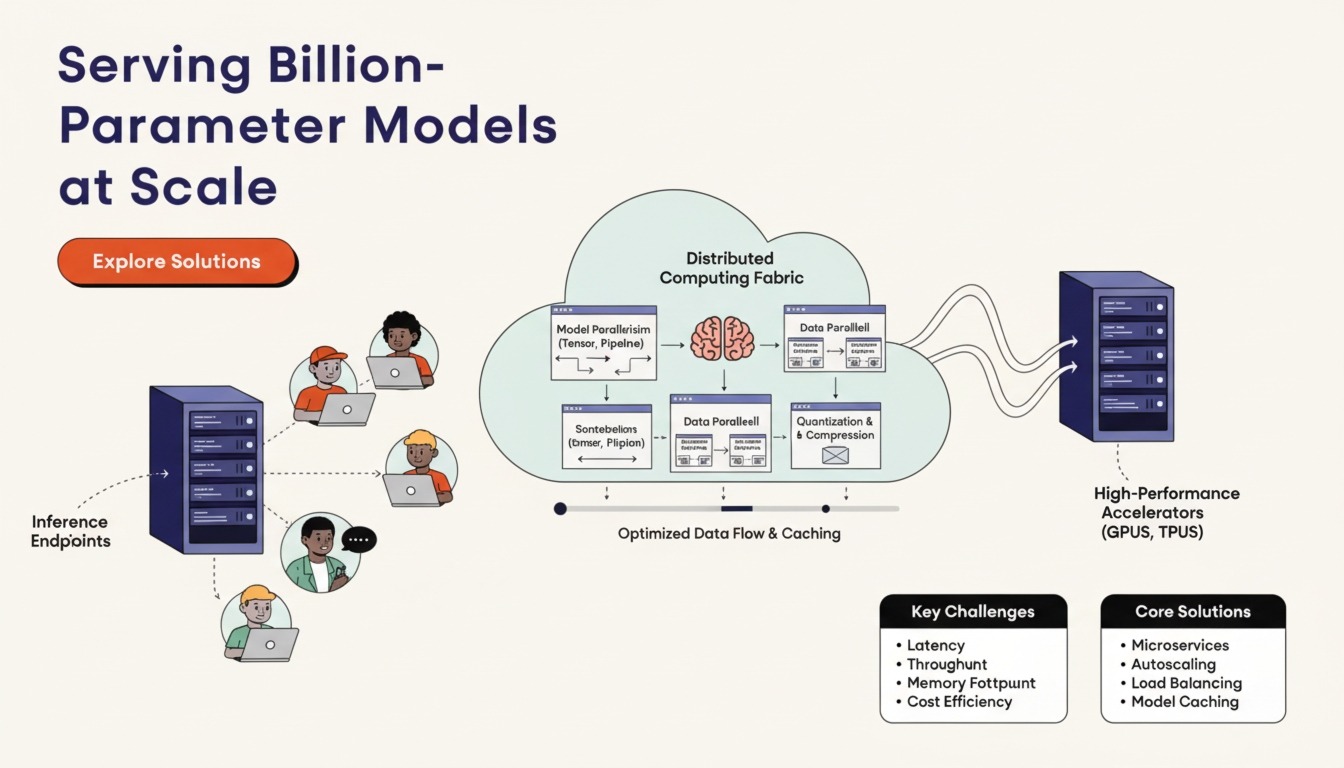
The rise of billion-parameter models has transformed the landscape of artificial intelligence, enabling breakthroughs in natural language processing, computer vision, and generative AI. However, deploying and serving these massive models at scale introduces significant technical and operational challenges. Organizations must balance performance, latency, and cost while maintaining reliability.
Understanding Billion-Parameter Models
Billion-parameter models, such as large language models (LLMs), consist of neural networks with billions of weights. These models require substantial computational resources for both training and inference. While training is resource-intensive, serving these models in real-time applications is equally complex due to strict latency and scalability requirements.
Applications like chatbots, recommendation engines, and AI assistants depend on fast and reliable inference, making efficient model serving critical.
Key Challenges in Serving at Scale
1. High Infrastructure Costs
Running large models requires powerful GPUs or specialized hardware. Maintaining such infrastructure—especially under fluctuating demand—can be expensive.
2. Latency Constraints
Users expect near-instant responses. However, large models naturally introduce higher inference latency, which can degrade user experience if not optimized.
3. Memory Limitations
Billion-parameter models often exceed the memory capacity of a single GPU, requiring model parallelism or offloading techniques.
4. Scalability Issues
Handling thousands or millions of concurrent requests demands robust scaling strategies, including load balancing and distributed systems.
Architecture for Scalable Model Serving
A well-designed architecture is essential for serving large models efficiently. Key components include:
Model Sharding and Parallelism
Split the model across multiple GPUs or nodes using tensor parallelism or pipeline parallelism. This allows large models to run without exceeding hardware limits.
Inference Optimization Layer
Use optimized runtimes such as TensorRT, ONNX Runtime, or custom inference engines to reduce latency and improve throughput.
Request Routing and Load Balancing
Distribute incoming requests across multiple instances using load balancers. Intelligent routing ensures efficient resource utilization.
Caching Mechanisms
Cache frequent queries or intermediate results to reduce redundant computations and improve response times.
Autoscaling Infrastructure
Leverage cloud platforms to dynamically scale resources based on demand, ensuring cost efficiency and performance stability.
Optimization Techniques
1. Model Quantization
Reduce model size by converting weights from high precision (e.g., FP32) to lower precision (e.g., INT8). This decreases memory usage and speeds up inference.
2. Pruning and Distillation
Remove redundant parameters or train smaller models to mimic larger ones, maintaining performance while reducing computational requirements.
3. Batching Requests
Process multiple inference requests together to maximize GPU utilization and improve throughput.
4. Efficient Tokenization and Input Handling
Optimize preprocessing steps to minimize overhead before inference begins.
5. Edge Deployment
For latency-sensitive applications, deploy smaller versions of models closer to users using edge computing.
Cost Management Strategies
Serving billion-parameter models can quickly become cost-prohibitive. Effective strategies include:
- Using spot instances or reserved cloud pricing
- Implementing autoscaling to avoid idle resources
- Monitoring usage patterns to optimize allocation
- Leveraging hybrid architectures (cloud + on-premise)
Balancing cost with performance is a continuous optimization process.
Monitoring and Reliability
To ensure smooth operations, implement robust monitoring systems:
- Track latency, throughput, and error rates
- Use observability tools like Prometheus and Grafana
- Set up alerts for performance degradation
- Conduct regular load testing
Reliability is critical, especially for customer-facing applications.
Real-World Use Cases
Companies deploying large-scale AI systems—such as virtual assistants, AI copilots, and recommendation platforms—rely heavily on scalable model serving. For instance, an AI-powered customer support system must handle thousands of queries simultaneously while maintaining low response times.
Similarly, content generation platforms require high throughput to serve multiple users without delays.
Future Trends
The future of serving billion-parameter models lies in:
- Specialized AI hardware (TPUs, custom accelerators)
- Serverless inference platforms
- Improved model compression techniques
- Federated and decentralized AI systems
These advancements will make large-scale AI more accessible and efficient.
Conclusion
Serving billion-parameter models at scale is a complex but essential capability in modern AI systems. By combining efficient architecture, optimization techniques, and cost management strategies, organizations can deliver high-performance AI solutions that meet real-world demands.
As AI continues to evolve, mastering scalable model serving will be a key differentiator for businesses aiming to stay ahead in the competitive technology landscape.