Real-time ray tracing has transformed visual fidelity in modern games, enabling physically accurate lighting, reflections, and shadows. However, ray tracing workloads are notoriously difficult for GPUs to execute efficiently. One of the biggest challenges is shader divergence, where different rays follow vastly different execution paths. Shader Execution Reordering (SER) directly addresses this problem and represents a major evolution in GPU ray tracing performance.
Understanding the Problem: Shader Divergence
Traditional rasterization benefits from coherent execution. Pixels processed together often execute the same shader instructions in lockstep. Ray tracing breaks this assumption. Rays may hit different geometry, materials, or lighting paths, causing threads within the same GPU warp to diverge. When divergence occurs, the GPU must serialize execution paths, leaving many lanes idle and dramatically reducing performance.
As ray depth increases—through reflections, refractions, and global illumination—the divergence problem compounds. Even powerful GPUs struggle to maintain high occupancy and utilization under these conditions, making ray tracing expensive despite hardware acceleration.
What Is Shader Execution Reordering (SER)?
Shader Execution Reordering is a GPU-level scheduling technique that allows ray tracing workloads to be dynamically reordered at runtime. Instead of executing rays strictly in the order they are generated, SER groups rays with similar execution paths and shader requirements.
This reordering happens after ray traversal decisions are known, meaning rays that hit similar materials or require the same shading logic are executed together. The result is improved coherence, fewer divergent branches, and much higher GPU efficiency.
How SER Works Under the Hood
SER operates by separating ray traversal from shading execution. Once rays intersect with geometry, the GPU records key execution attributes such as material type, shader permutation, or lighting path. These rays are then queued and regrouped based on similarity before shading begins.
By doing this, SER ensures that GPU warps execute more uniform instruction streams. This significantly reduces idle lanes and allows better utilization of SIMD execution units. Importantly, SER does not change visual output—only execution order—making it a purely performance-focused optimization.
Performance Impact on Ray Tracing Pipelines
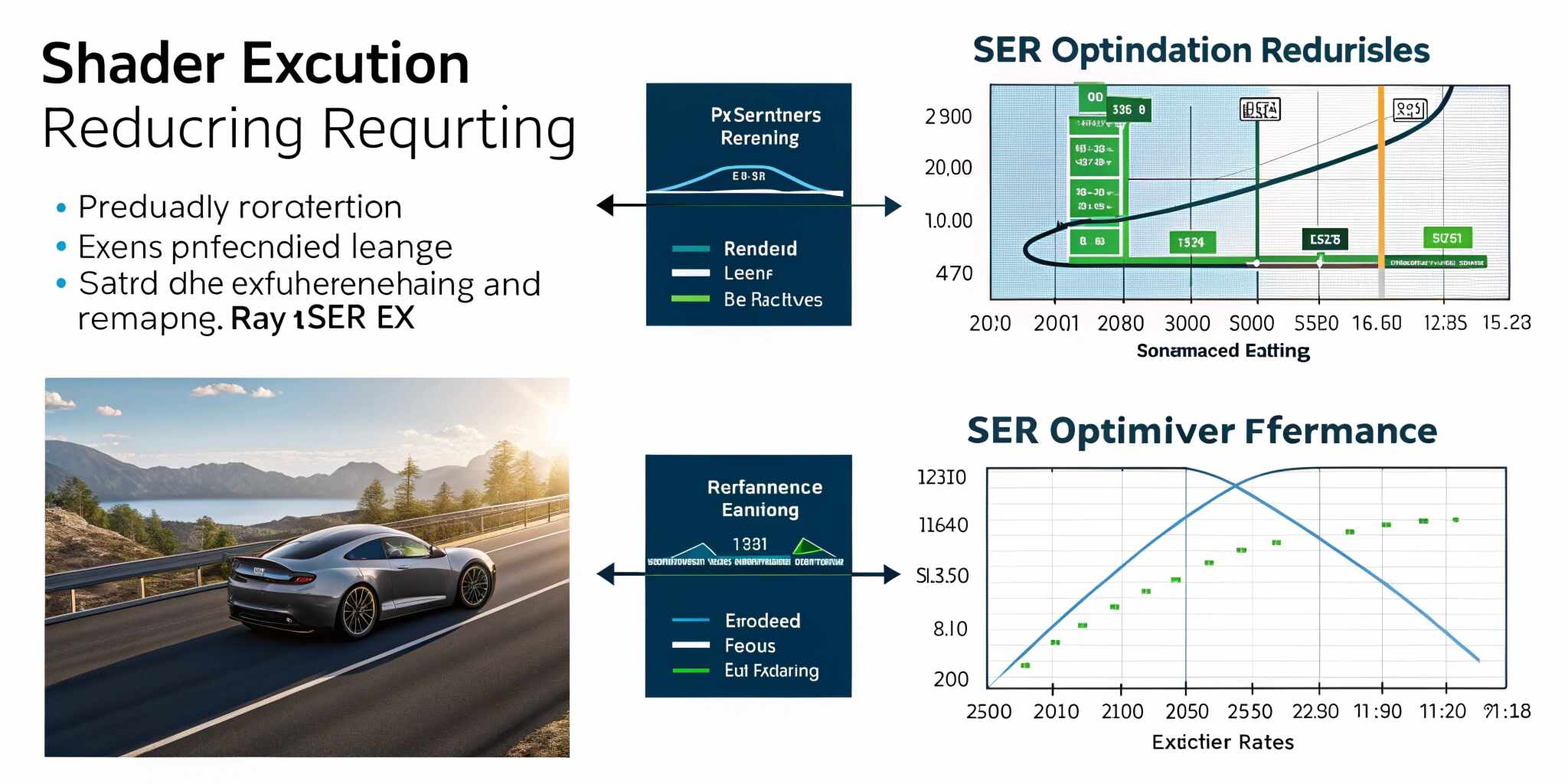
The performance gains from SER are most noticeable in scenes with heavy ray divergence, such as reflective interiors, complex materials, or scenes with many secondary rays. Benchmarks show improvements ranging from modest gains in simple scenes to dramatic performance boosts in complex ray-traced workloads.
SER also helps stabilize frame times. By reducing execution variability, it minimizes worst-case shader paths that can cause frame spikes, which is critical for real-time applications like games and VR.
Integration into Modern Game Engines
Modern engines adopting advanced ray tracing pipelines can integrate SER with minimal architectural changes. SER works particularly well with deferred ray tracing, material-based shading queues, and data-oriented rendering architectures.
However, engines must be designed to expose sufficient shader metadata for effective reordering. Excessive shader permutations or overly complex material systems can reduce SER’s effectiveness. Thoughtful shader design and material consolidation are key to maximizing benefits.
SER vs Traditional Optimizations
Before SER, developers relied on techniques like ray sorting, shader specialization, and material batching. While effective, these approaches often required complex engine-side logic and static assumptions. SER shifts much of this responsibility to the GPU, enabling more flexible and dynamic optimization.
This makes SER especially valuable for large, procedural, or player-driven worlds where execution patterns are unpredictable.
The Future of Ray Tracing Performance
Shader Execution Reordering signals a broader shift toward GPU-driven scheduling and execution intelligence. As ray tracing becomes more prevalent, features like SER will be essential for scaling visual quality without exponential performance costs.
In the future, SER may integrate more deeply with AI-driven rendering, real-time path tracing, and fully GPU-driven engines. For developers targeting next-generation hardware, understanding and leveraging SER is quickly becoming a competitive advantage.