As mobile applications grow, many developers face the same problem: the app works — but maintaining it becomes a nightmare.
A simple feature addition suddenly breaks multiple screens. Fixing one bug creates two new ones. Refactoring feels risky, and onboarding new developers becomes difficult. The root cause is usually not technology — it is poor code structure.
This is exactly why the SOLID principles exist.
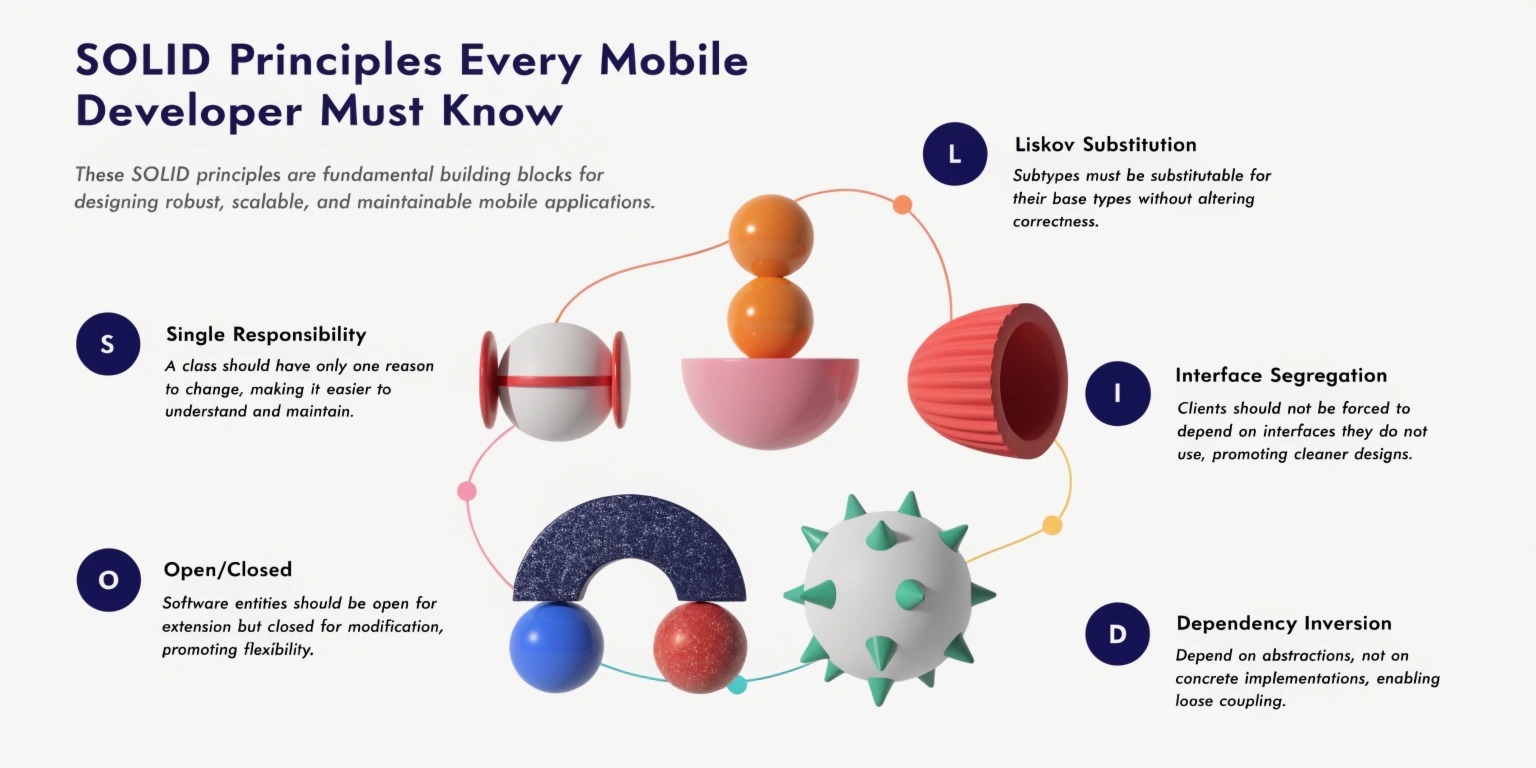
SOLID is a set of five object-oriented design principles that help developers write clean, scalable, and maintainable code. These principles are especially important in mobile development, where applications continuously evolve with new features, API changes, and device compatibility requirements.
Let’s understand each principle with mobile-focused examples.
1. Single Responsibility Principle (SRP)
A class should have only one reason to change.
In mobile apps, developers often create a “god class” — especially ViewModels or Controllers — that handles:
- API calls
- database storage
- validation
- UI formatting
- navigation
This creates tightly coupled code.
Wrong Approach
UserViewModel:
- fetches user from API
- saves to database
- validates email
- formats UI text
Now, any UI change, API change, or validation change affects the same class.
Correct Approach
Split responsibilities:
- UserRepository → data fetching
- UserValidator → validation
- UserFormatter → UI formatting
- UserViewModel → presentation logic
Now changes remain isolated.
Benefit: easier debugging and safer updates.
2. Open/Closed Principle (OCP)
Software entities should be open for extension but closed for modification.
You should be able to add features without rewriting existing code.
Mobile Example
Imagine a payment feature supporting:
- Credit Card
Later you add:
- UPI
- Wallet
- Net Banking
Bad Design
Add if-else blocks inside the same payment class. Each new method modifies existing code, increasing risk.
Good Design
Create a PaymentMethod interface:
- CardPayment
- UPIPayment
- WalletPayment
Now new methods are added as new classes, not modifications.
Benefit: safer feature expansion.
3. Liskov Substitution Principle (LSP)
Derived classes must be replaceable for their base classes.
In simple terms: child classes should behave logically like the parent.
Example
You create a base class:
MediaPlayer.play()
Child classes:
- AudioPlayer
- VideoPlayer
If VideoPlayer throws error when audio-only content is played, it violates LSP because it cannot substitute the base behavior correctly.
In mobile apps, this often happens in repositories or services when subclasses change expected behavior.
Benefit: predictable functionality and fewer runtime crashes.
4. Interface Segregation Principle (ISP)
Clients should not be forced to depend on methods they do not use.
Large interfaces create unnecessary implementation burden.
Example
A UserDataSource interface contains:
- login()
- logout()
- uploadProfileImage()
- fetchLocation()
A local database class implementing this should not be forced to implement location fetching or upload features.
Instead, split interfaces:
- AuthDataSource
- ProfileDataSource
- LocationDataSource
Benefit: cleaner implementation and better modularity.
5. Dependency Inversion Principle (DIP)
High-level modules should not depend on low-level modules. Both should depend on abstractions.
This is the most important principle in modern mobile architecture.
Problem
ViewModel directly calls API service.
ViewModel → RetrofitService
Now testing becomes difficult because the real network call executes.
Solution
Introduce abstraction:
ViewModel → UserRepository (interface) → ApiRepository (implementation)
Using dependency injection (Hilt/Dagger/Koin on Android, Resolver/Swinject on iOS), we can swap implementations.
Now for testing:
- use mock repository
- no network required
Benefit: testable code and flexible architecture.
How SOLID Fits Modern Mobile Architecture
SOLID is the foundation of:
- Clean Architecture
- MVVM
- VIPER (iOS)
- Modular architecture
Without SOLID, these architectures collapse into tightly coupled code.
Real Benefits in Mobile Projects
- Easier feature updates
- Faster bug fixing
- Safer refactoring
- Better teamwork
- Easier onboarding of new developers
- Improved app stability
- Higher code reusability
Large apps (banking, e-commerce, social media) rely heavily on these principles to remain maintainable over years.
Common Mistakes
- Using MVVM but ignoring SRP
- Creating large repositories
- Skipping interfaces
- Hardcoding dependencies
- Overengineering very small apps
SOLID should simplify code — not complicate it.
Final Thoughts
SOLID principles are not academic theory. They are practical guidelines that prevent your mobile app from becoming unmanageable as it grows.
A small app may work without SOLID. A production app cannot survive without it.
Mastering these principles turns a developer from someone who writes working code into someone who builds sustainable software systems.
In professional mobile development, clean code is not a luxury — it is a requirement. And SOLID is the starting point.