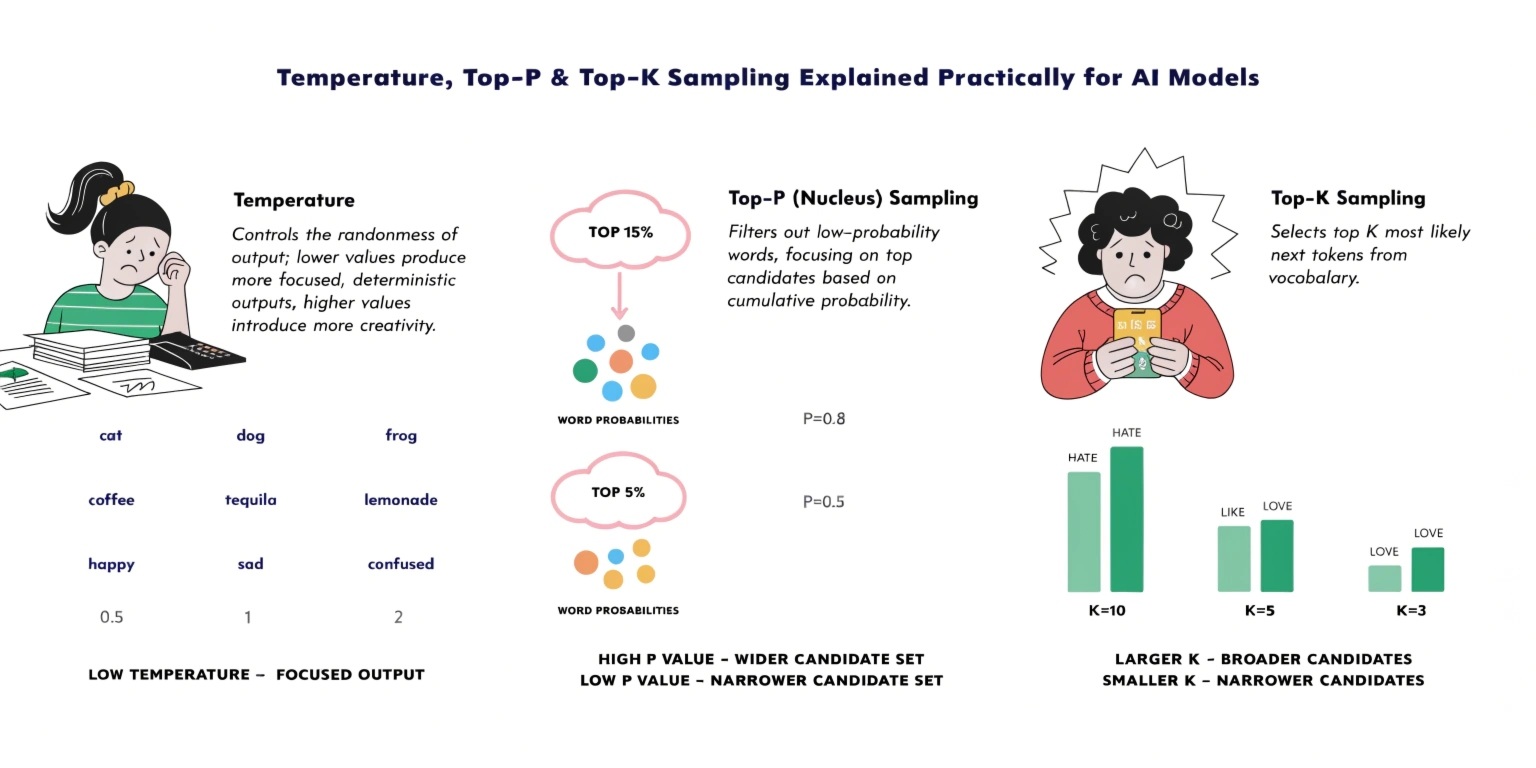
Modern AI text generation models rely on probability to decide which word comes next in a sentence. While this may sound simple, controlling how these probabilities are used is what determines whether the output is creative, repetitive, or accurate. This is where sampling techniques like temperature, top-k, and top-p come into play.
These techniques are widely used in systems built on Natural Language Processing and large language models to fine-tune outputs for different use cases.
Why Sampling Matters in AI
When an AI model generates text, it doesn’t pick the most likely word every time. Instead, it samples from a probability distribution of possible next words. Without proper control, the output can become:
- Too predictable (boring and repetitive)
- Too random (nonsensical or irrelevant)
Sampling techniques help strike the right balance between creativity and coherence.
1. Temperature: Controlling Randomness
Temperature is the simplest and most commonly used parameter.
It adjusts how “confident” the model is when choosing the next word.
- Low temperature (0.1 – 0.3):
- Output is more deterministic and focused
- Best for factual answers, coding, and summaries
- Medium temperature (0.5 – 0.7):
- Balanced creativity and coherence
- Ideal for general-purpose content
- High temperature (0.8 – 1.0+):
- More randomness and creativity
- Useful for storytelling or brainstorming
Practical Example:
If the model predicts:
- "cat" (60%)
- "dog" (30%)
- "tiger" (10%)
At low temperature → “cat” is almost always chosen
At high temperature → even “tiger” might appear
Temperature essentially smooths or sharpens the probability distribution.
2. Top-K Sampling: Limiting Choices
Top-K sampling restricts the model to choose from the top K most probable words.
- If K = 3, only the top 3 probable words are considered
- If K = 10, the model has more options
Benefits:
- Prevents extremely unlikely words from being selected
- Maintains a balance between diversity and quality
Example:
If probabilities are:
- cat (60%), dog (30%), tiger (10%), elephant (5%)
With Top-K = 2, only “cat” and “dog” are considered
This eliminates low-probability noise.
3. Top-P (Nucleus Sampling): Dynamic Filtering
Top-P sampling is more flexible than Top-K.
Instead of selecting a fixed number of words, it selects the smallest set of words whose cumulative probability exceeds P.
- If P = 0.9, the model picks from words that together make up 90% probability
- The number of words can vary dynamically
Why it’s powerful:
- Adapts based on context
- Avoids both overly strict and overly loose selection
Example:
Probabilities:
- cat (50%), dog (30%), tiger (10%), lion (5%), fox (5%)
With Top-P = 0.9, the model selects:
- cat + dog + tiger (total 90%)
Words like “lion” and “fox” are excluded.
Top-K vs Top-P: Key Differences
FeatureTop-KTop-P (Nucleus)SelectionFixed number of wordsDynamic probability cutoffFlexibilityLess flexibleMore adaptiveUse CaseControlled outputsNatural language flow
In practice, Top-P is often preferred because it adapts better to different contexts.
Combining These Techniques
These parameters are often used together:
- Temperature + Top-P → Most common combination
- Temperature + Top-K → More controlled generation
For example:
- Temperature = 0.7
- Top-P = 0.9
This setup provides a good balance between creativity and coherence.
Practical Use Cases
1. Chatbots
Use low temperature and moderate Top-P for accurate responses.
2. Content Writing
Use medium temperature and Top-P for engaging, natural text.
3. Creative Writing
Use high temperature and high Top-P for maximum creativity.
4. Code Generation
Use low temperature and low Top-K to ensure correctness.
Common Mistakes
- Using high temperature without filtering → leads to nonsense output
- Very low Top-K (e.g., K=1) → overly repetitive text
- Ignoring parameter tuning → suboptimal results
Best Practices
- Start with Temperature = 0.7 and Top-P = 0.9
- Adjust based on output quality
- Test multiple configurations
- Monitor consistency vs creativity trade-offs
Final Thoughts
Temperature, Top-K, and Top-P are essential tools for controlling how AI models generate text. Understanding these parameters allows developers and content creators to fine-tune outputs based on their specific needs.
Rather than relying on default settings, experimenting with these values can significantly improve the quality, relevance, and creativity of AI-generated content.
Mastering these sampling techniques is a key step toward building smarter, more reliable AI applications.