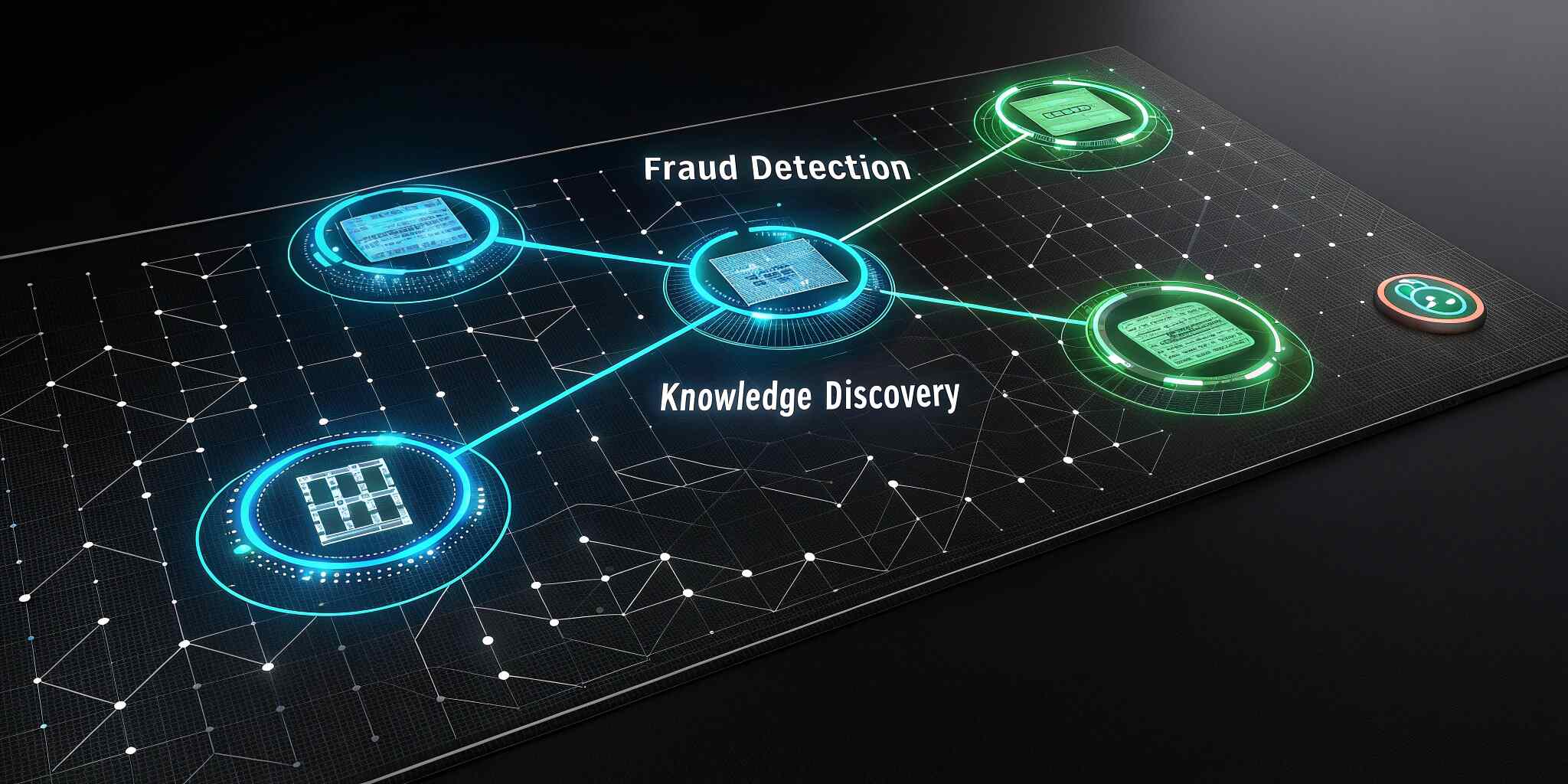
In today’s interconnected world, data relationships matter as much as the data itself. Traditional relational databases often struggle to capture these connections at scale. Enter graph databases — a powerful technology designed to model and analyze highly connected data. Their ability to reveal hidden relationships is proving invaluable in two critical areas: fraud detection and knowledge discovery.
Why Graph Databases?
Unlike relational databases that store information in rigid tables, graph databases represent data as nodes (entities) and edges (relationships). This structure mirrors real-world networks, such as social connections, transactions, and knowledge systems. The result is faster querying, more intuitive modeling, and the ability to uncover patterns traditional systems often miss.
With fraud schemes becoming increasingly complex and knowledge systems expanding, graph databases provide the flexibility and scalability required for the future of data-driven decision-making.
Fraud Detection with Graph Databases
Fraudsters constantly evolve their tactics, creating intricate webs of activity that evade traditional detection methods. Graph databases are uniquely positioned to combat these threats.
1. Detecting Hidden Relationships
In financial fraud, criminals often use multiple accounts, intermediaries, or shell companies to conceal activities. Graph algorithms can uncover these hidden links, exposing fraudulent networks in real time.
2. Real-Time Anomaly Detection
By integrating with streaming platforms, graph databases can analyze transactions as they occur. Suspicious patterns — like rapid transfers between connected accounts — trigger alerts instantly, reducing the time between fraud and detection.
3. Scalable Analysis
Banks, insurance companies, and e-commerce platforms deal with billions of transactions. Graph databases scale horizontally, enabling large-scale fraud analysis without performance bottlenecks.
Example: A global bank leveraging Neo4j can identify money laundering rings by tracing indirect connections between accounts that appear unrelated in a traditional relational database.
Knowledge Discovery with Graph Databases
Beyond fraud detection, graph databases excel in uncovering new knowledge from vast datasets.
1. Building Knowledge Graphs
Organizations can integrate data from multiple sources into a unified knowledge graph. This empowers researchers, analysts, and AI systems to explore connected information seamlessly.
2. Enhancing AI Models
AI systems thrive on context. Graph databases provide structured relationships that improve natural language processing, recommendation engines, and semantic search capabilities.
3. Accelerating Research and Innovation
In healthcare, graph databases help uncover links between genes, diseases, and treatments. In academia, they map citations, collaborations, and knowledge flows to accelerate discovery.
Example: Google’s Knowledge Graph powers search results by connecting entities like people, organizations, and places — providing users with contextual and accurate answers.
The Future of Graph Databases
Graph databases are set to play an even bigger role in the coming years, fueled by advancements in AI and real-time analytics.
- Integration with Machine Learning: Graph embeddings enable ML models to learn from complex relationships, improving fraud prediction and knowledge inference.
- Cloud-Native Graph Services: Managed graph database services will lower adoption barriers, making the technology accessible to more organizations.
- Industry-Wide Adoption: Finance, healthcare, cybersecurity, e-commerce, and government sectors will increasingly adopt graph solutions for mission-critical tasks.
- Explainable AI (XAI): Graph structures provide transparency, allowing organizations to understand why a model flagged a transaction as fraudulent or suggested a new research connection.
Challenges to Overcome
Despite their promise, graph databases face hurdles:
- Skill Gap: Developers and data scientists need specialized training.
- Integration Complexity: Migrating from relational systems can be resource-intensive.
- Standardization: Unlike SQL, graph query languages (like Cypher or Gremlin) lack universal standards.
However, as ecosystems mature, these challenges are likely to diminish.
Conclusion
The future of graph databases in fraud detection and knowledge discovery is bright. By uncovering hidden patterns, enabling real-time detection, and driving contextual knowledge discovery, they provide organizations with a competitive edge in an increasingly data-driven world.
As fraudsters grow more sophisticated and data grows more complex, graph databases will be the backbone of intelligent, secure, and knowledge-rich applications. For businesses looking ahead, adopting graph-powered strategies isn’t just an option — it’s a necessity.