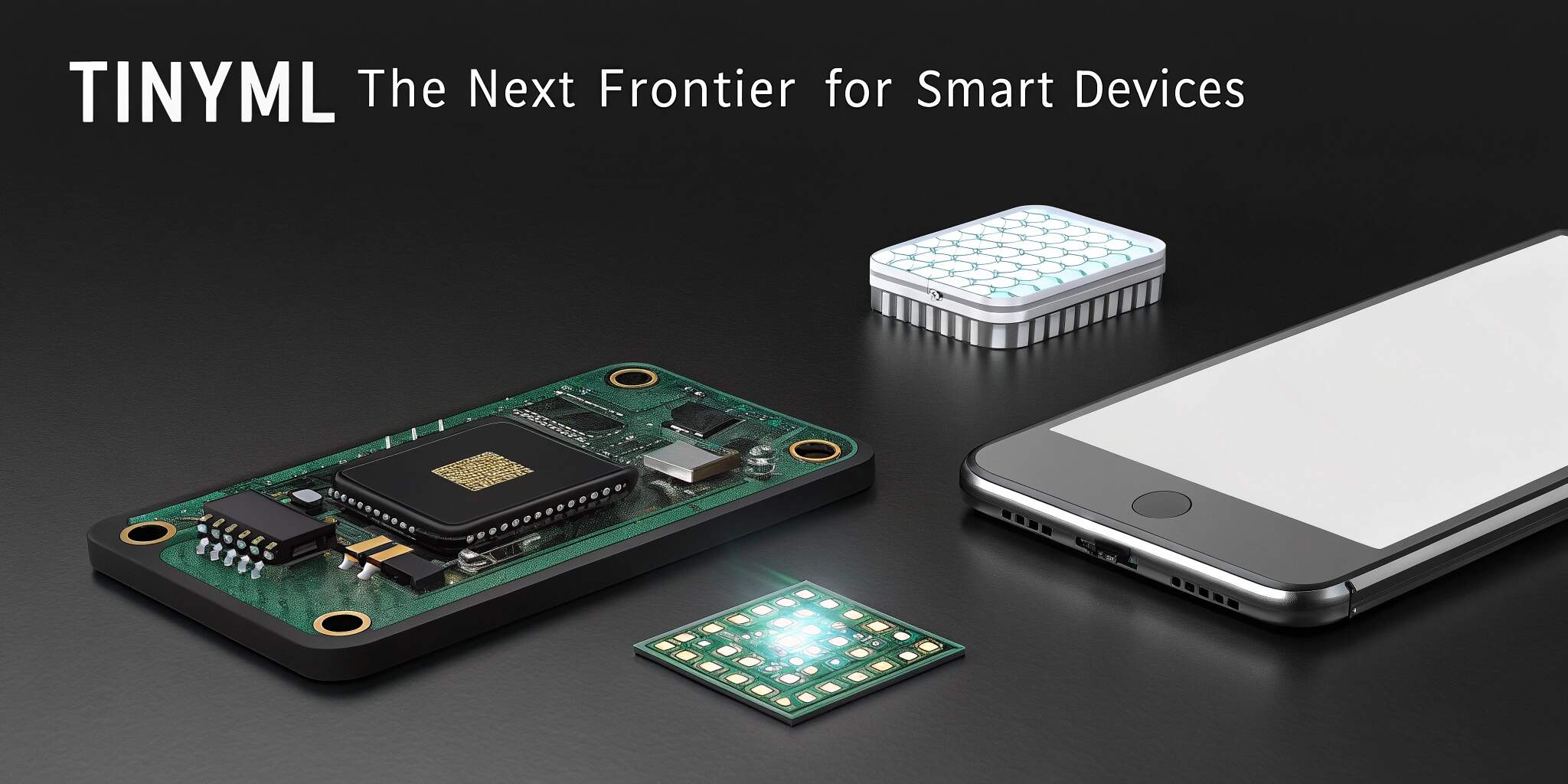
Artificial Intelligence (AI) has rapidly evolved from running on massive cloud infrastructures to operating on compact, low-power devices. This revolution is powered by TinyML (Tiny Machine Learning) — a cutting-edge approach that embeds machine learning models directly onto microcontrollers and small hardware components. In 2025, as businesses demand real-time, energy-efficient, and privacy-centric AI solutions, TinyML is emerging as a transformative force across industries.
What Is TinyML?
TinyML is a subset of machine learning that focuses on deploying lightweight AI models on devices with limited computational power and memory — typically under a few milliwatts of power consumption. These devices include sensors, wearables, smart home gadgets, and industrial machines. Unlike traditional AI systems that rely heavily on cloud computing, TinyML enables on-device inference, allowing data to be processed locally without sending it to the cloud.
This shift dramatically reduces latency, conserves bandwidth, and enhances data privacy. TinyML empowers devices to think and act independently, making them smarter and more responsive.
Why TinyML Matters
The rise of TinyML comes at a crucial time when the Internet of Things (IoT) ecosystem is expanding exponentially. Millions of connected devices continuously collect data, but transmitting all this information to centralized servers is costly and inefficient. TinyML bridges this gap by bringing intelligence to the edge, enabling devices to process and analyze data in real time.
For example, a smart thermostat equipped with TinyML can learn user behavior patterns and automatically adjust temperature settings without relying on a constant internet connection. Similarly, industrial sensors can detect anomalies and prevent equipment failures before they occur.
Key Advantages of TinyML
- Low Power Consumption: TinyML models are designed to run on minimal energy, making them perfect for battery-powered or energy-harvesting devices.
- Enhanced Privacy: Since data processing occurs locally, sensitive information doesn’t need to leave the device, minimizing security risks.
- Real-Time Decision Making: On-device processing allows instant responses, which is essential in time-critical applications like healthcare monitoring and autonomous systems.
- Scalability: TinyML enables billions of IoT devices to perform AI tasks simultaneously without burdening cloud infrastructure.
- Cost Efficiency: Reduced dependence on cloud computing translates into lower data transfer and storage costs.
Applications of TinyML
TinyML is already transforming multiple sectors:
- Healthcare: Wearables equipped with TinyML can track heart rate, detect arrhythmias, or monitor sleep patterns in real time.
- Agriculture: Smart sensors in fields can analyze soil moisture and weather conditions to optimize irrigation systems.
- Manufacturing: Predictive maintenance powered by TinyML helps detect faults early and minimizes downtime.
- Smart Homes: Devices like security cameras, voice assistants, and appliances use TinyML for motion detection and automation.
- Environmental Monitoring: TinyML sensors track air quality, noise pollution, and wildlife movements efficiently in remote areas.
How TinyML Works
TinyML operates through a process of model optimization — compressing large AI models into compact versions suitable for microcontrollers. Techniques like quantization, pruning, and model distillation reduce the size of neural networks without significantly compromising performance.
Frameworks such as TensorFlow Lite for Microcontrollers (TFLM), Edge Impulse, and PyTorch Mobile enable developers to train, compress, and deploy models efficiently. These tools make TinyML accessible to a wide range of developers and organizations.
Challenges of TinyML
Despite its advantages, TinyML is not without challenges. Limited memory and processing power restrict the complexity of models that can be deployed. Additionally, updating and maintaining on-device models across large IoT networks can be difficult. However, advancements in hardware accelerators and AI compilers are gradually overcoming these limitations, making TinyML more robust and scalable.
Future Outlook
As the world moves toward ubiquitous computing, TinyML will play a key role in making devices more autonomous and sustainable. The next generation of chips — combining AI acceleration, ultra-low-power processing, and neuromorphic architectures — will take TinyML capabilities to new heights.
By 2025 and beyond, TinyML will be a cornerstone of smart cities, healthcare innovation, and industrial automation, enabling a world where even the smallest devices possess intelligent capabilities.
Conclusion
TinyML represents a paradigm shift in how AI is deployed, shifting intelligence from the cloud to the edge. With its ability to run efficient, secure, and real-time machine learning models on small devices, TinyML is setting the stage for a new era of smart, sustainable, and connected technology. For enterprises and developers alike, the future of AI is not just big — it’s tiny.