Large Language Models (LLMs) have revolutionized artificial intelligence by generating human-like text, answering questions, writing code, and assisting with countless business tasks. However, traditional LLMs have one major limitation—they cannot directly interact with external systems or access live information on their own.
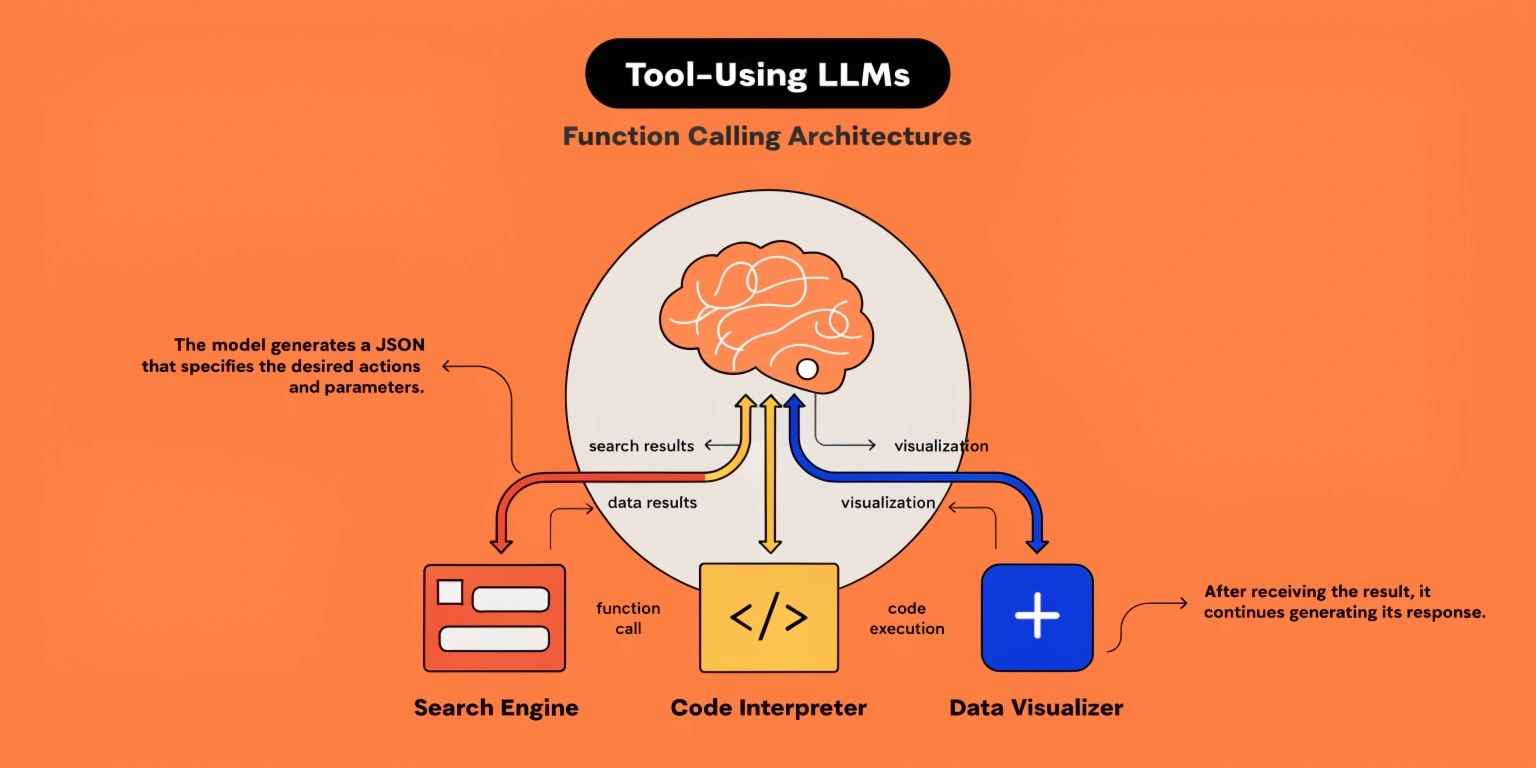
This limitation has led to the development of Tool-Using LLMs, powered by Function Calling Architectures. Instead of relying solely on internal knowledge, these AI models can securely call APIs, retrieve database records, perform calculations, schedule appointments, send emails, or even control business software.
Function calling is transforming LLMs from conversational assistants into intelligent digital workers capable of completing real-world tasks.
What Are Tool-Using LLMs?
Tool-Using LLMs are language models that can invoke predefined functions whenever a user's request requires information or actions beyond the model's built-in knowledge.
Rather than generating hypothetical answers, the model determines whether an external tool is needed. If so, it generates a structured function call, allowing backend applications to execute the requested action before returning verified results.
For example, if a user asks:
"What's the current weather in Surat?"
Instead of guessing, the LLM calls a weather API and returns accurate, real-time information.
Similarly, if someone asks:
"Book a meeting tomorrow at 3 PM."
The LLM can call a calendar service to create the appointment automatically.
Understanding Function Calling Architecture
A function calling architecture generally consists of several components working together.
1. User Request
The user submits a natural language query.
Example:
"Find available flights from Mumbai to Singapore next Friday."
2. Intent Recognition
The LLM analyzes whether the request requires external data or system actions.
3. Function Selection
The AI identifies the appropriate predefined function, such as:
- Search Flights
- Get Weather
- Create Calendar Event
- Retrieve Customer Details
- Process Payment
4. Parameter Extraction
The model extracts required inputs like:
- Departure city
- Destination
- Date
- Number of passengers
These values are structured into a machine-readable format.
5. Backend Execution
The application executes the selected function by interacting with APIs, databases, or enterprise software.
6. Final Response
The external system returns data, and the LLM converts it into a user-friendly response.
This architecture combines natural language understanding with reliable software execution.
Why Function Calling Matters
Traditional LLMs generate responses based on learned patterns, which can occasionally produce outdated or incorrect information.
Function calling addresses these limitations by enabling AI to access trusted, real-time data sources.
Key benefits include:
- Real-time information retrieval
- Reduced hallucinations
- Secure API integration
- Automated workflows
- Improved reliability
- Better enterprise adoption
- Enhanced customer experiences
Instead of pretending to know an answer, the AI retrieves verified information directly from authoritative systems.
Real-World Applications
Customer Support
AI assistants can:
- Check order status
- Issue refunds
- Update shipping addresses
- Reset passwords
- Retrieve customer history
without requiring human intervention.
Healthcare
Medical assistants can:
- Schedule appointments
- Access patient records (with authorization)
- Retrieve lab reports
- Send prescription reminders
while maintaining privacy and compliance.
Finance
Financial assistants can:
- Retrieve account balances
- Display transaction history
- Calculate loan payments
- Monitor investments
- Generate financial reports
using secure banking APIs.
E-commerce
Retail platforms use function calling to:
- Check inventory
- Recommend products
- Process returns
- Calculate shipping costs
- Apply promotional discounts
in real time.
Software Development
Developer assistants can:
- Execute code
- Query documentation
- Search repositories
- Create Git commits
- Open pull requests
- Generate deployment pipelines
making software development significantly more efficient.
Advantages of Tool-Using LLMs
Greater Accuracy
Responses come directly from verified systems rather than model memory.
Automation
Routine business processes become fully automated.
Scalability
Organizations can serve thousands of customers simultaneously.
Flexibility
New tools and APIs can be integrated without retraining the LLM.
Better Decision-Making
Businesses gain access to current information for informed decisions.
Challenges
Despite their advantages, function calling introduces several technical considerations.
Security
External tools must validate permissions to prevent unauthorized access.
API Reliability
If an external service becomes unavailable, the AI should gracefully handle errors.
Input Validation
Incorrect or malicious inputs should never be passed directly to backend systems.
Cost
Multiple API calls may increase operational expenses.
Latency
Calling external services can increase response times if not optimized.
Proper architecture design helps mitigate these challenges while maintaining performance.
Best Practices for Building Tool-Using LLMs
Organizations should follow several best practices:
- Define functions with clear schemas.
- Validate all user inputs before execution.
- Limit tool permissions based on user roles.
- Log function calls for auditing.
- Implement retries and fallback mechanisms.
- Use authentication and encryption for API communication.
- Keep prompts concise and context-aware.
- Continuously monitor tool performance and accuracy.
These practices ensure reliable and secure AI-powered applications.
The Future of Function Calling Architectures
Function calling is becoming the foundation of modern AI agents. Future LLMs will seamlessly coordinate multiple tools, reason across complex workflows, and collaborate with other AI systems to accomplish sophisticated tasks.
As organizations increasingly integrate AI into customer service, healthcare, finance, software engineering, and enterprise operations, tool-using LLMs will play a central role in driving automation and productivity.
The evolution from conversational AI to action-oriented AI marks a significant milestone in artificial intelligence. By combining language understanding with external tools and APIs, function calling architectures transform LLMs into capable digital assistants that not only provide information but also execute meaningful tasks. Businesses adopting this technology today are well-positioned to deliver faster, smarter, and more personalized experiences while unlocking new opportunities for innovation and operational efficiency.