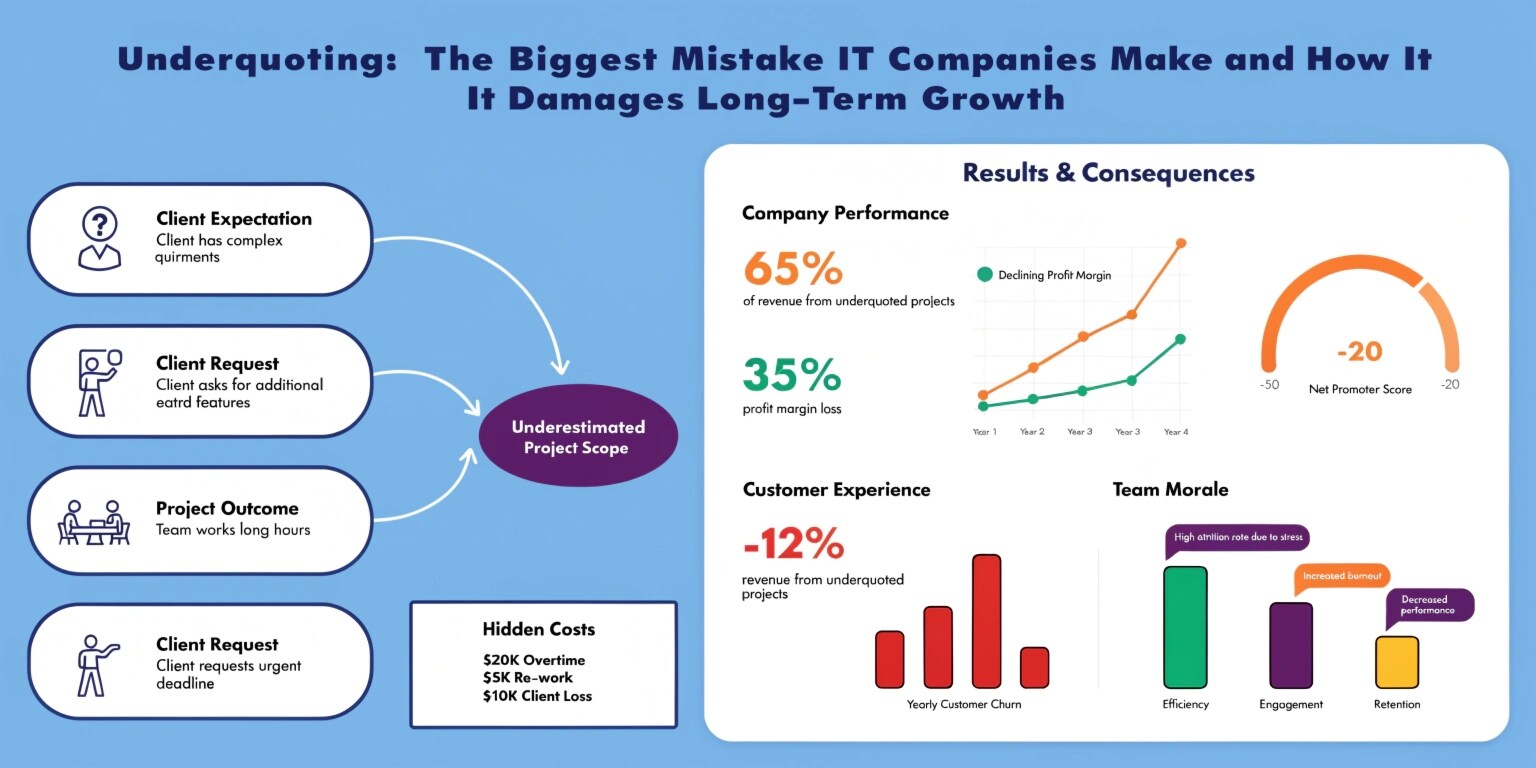
In the competitive world of IT services, many companies feel pressure to win clients quickly. To secure deals, they often lower their project prices beyond reasonable limits. While this strategy may seem effective initially, underquoting is one of the biggest mistakes IT companies make.
Underquoting refers to offering project costs significantly lower than the actual effort, resources, and time required. This mistake can harm not only profitability but also team productivity, project quality, and client relationships.
Let’s explore why underquoting happens and how IT companies can avoid this costly mistake.
Why IT Companies Underquote Projects
1. Fear of Losing the Client
Many IT companies believe that lower pricing increases their chances of winning projects. When competing against multiple agencies or freelancers, companies sometimes reduce their quotes drastically just to secure the deal.
However, winning a project at an unrealistic price often leads to future problems.
2. Poor Project Estimation
Underquoting often occurs because teams underestimate the complexity of the project. Lack of proper requirement analysis leads to incorrect estimates of development time, testing effort, and maintenance costs.
For example, a simple mobile app may require integrations, security features, performance optimization, and UI improvements that were not initially considered.
3. Lack of Experience in Pricing
New IT companies and freelancers frequently struggle with pricing strategies. Without historical project data or experience, they may quote randomly or follow competitors blindly.
This results in pricing that does not reflect the actual value of their services.
4. Pressure from Sales Teams
Sometimes sales teams promise lower pricing to close deals quickly. They prioritize acquiring clients over project feasibility, leaving the development team struggling to deliver within unrealistic budgets.
This internal misalignment can damage company operations.
Consequences of Underquoting
1. Reduced Profit Margins
The most obvious consequence of underquoting is financial loss. When projects take more time and resources than estimated, the company absorbs the extra cost.
Over time, repeated underquoting can severely affect company profitability.
2. Team Burnout
When budgets are too low, developers are forced to work longer hours to meet deadlines. This pressure leads to stress, burnout, and reduced job satisfaction among employees.
High employee turnover is often linked to poorly priced projects.
3. Compromised Quality
Limited budgets restrict testing, code optimization, and documentation efforts. As a result, the final product may contain bugs, performance issues, or poor user experience.
Low-quality delivery can damage the company's reputation.
4. Client Relationship Issues
Underquoted projects frequently lead to scope disputes. As the company realizes the project requires more work than expected, they may request additional payments.
Clients may feel misled, creating tension and reducing the chances of long-term partnerships.
How IT Companies Can Avoid Underquoting
1. Conduct Proper Requirement Analysis
Before quoting any project, companies must thoroughly understand client requirements. Detailed discussions, technical evaluations, and documentation help teams estimate realistic costs.
A discovery phase can significantly reduce estimation errors.
2. Break Down the Project Scope
Dividing the project into smaller modules improves estimation accuracy. For example:
- UI/UX Design
- Backend Development
- API Integration
- Testing and QA
- Deployment and Maintenance
Each component can then be priced individually.
3. Use Historical Data
Experienced IT companies maintain records of past projects. This data helps estimate time and cost more accurately for future projects.
If a similar project took 500 hours previously, the next estimate can be adjusted based on that benchmark.
4. Include Buffer Time
Unexpected challenges are common in software development. Adding a buffer of 10–20% in project timelines and budgets helps handle unforeseen issues.
This prevents teams from operating under extreme pressure.
5. Educate Clients About Value
Instead of competing solely on price, IT companies should communicate the value they offer. Highlighting expertise, reliability, and long-term support helps justify fair pricing.
Clients who understand value are more willing to pay realistic costs.
6. Implement Structured Pricing Models
Using standard pricing models improves consistency. Common models include:
- Fixed Price Model
- Time and Material Model
- Dedicated Team Model
Selecting the right pricing structure helps balance flexibility and profitability.
Final Thoughts
Underquoting might seem like an easy way to win projects, but it often leads to long-term damage for IT companies. Reduced profits, stressed employees, and dissatisfied clients are common consequences.
Successful IT companies focus on accurate estimation, transparent communication, and value-based pricing rather than competing only on low cost.
By developing better pricing strategies and understanding project requirements deeply, IT businesses can build sustainable growth, maintain team satisfaction, and deliver high-quality solutions to their clients.