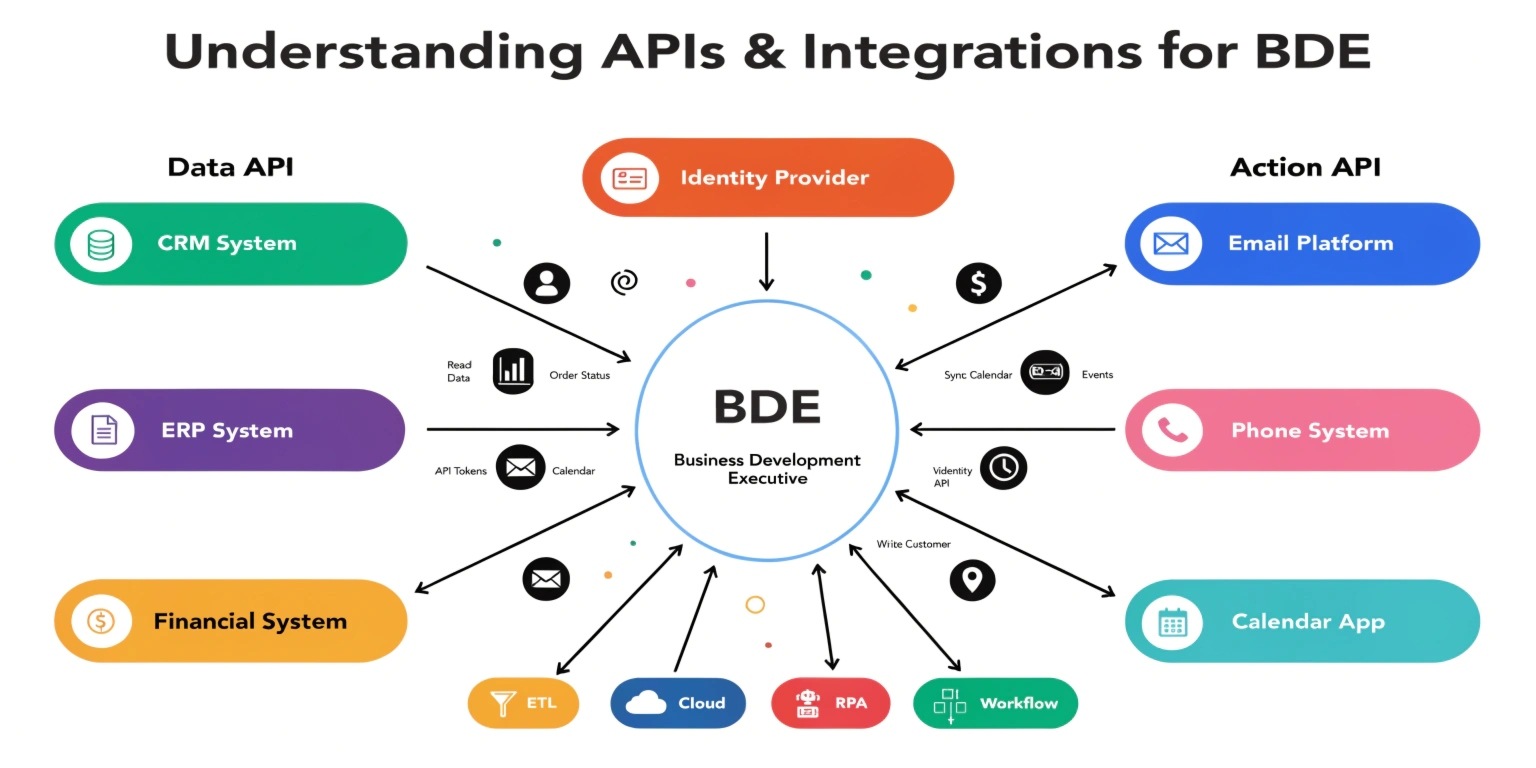
In today’s digital-first world, Business Development Executives (BDEs) working in IT companies are expected to understand not just sales strategies, but also basic technical concepts. Among these, APIs and integrations are some of the most commonly discussed—and often misunderstood—topics.
If you’ve ever been in a client call where terms like “API integration,” “REST services,” or “third-party connectivity” were mentioned, this guide is designed to help you confidently navigate those conversations.
What is an API?
API stands for Application Programming Interface. In simple terms, an API is a bridge that allows two different software systems to communicate with each other.
Think of an API like a waiter in a restaurant:
- The customer (user) places an order
- The waiter (API) takes it to the kitchen (server)
- The kitchen prepares the food and sends it back through the waiter
Similarly, an API takes a request from one system, sends it to another, and returns the response.
Real-Life Examples of APIs
To make it more relatable for BDEs:
- When you log in to a website using Google or Facebook, APIs are working in the background.
- Payment gateways like Razorpay or Stripe use APIs to process transactions.
- Weather apps fetch real-time data using external APIs.
These examples help you explain APIs to clients in a non-technical way, which builds trust and clarity.
What are Integrations?
While APIs are the tools, integrations are the result.
Integration means connecting different systems so they work together seamlessly. For example:
- A CRM connected with email marketing tools
- An e-commerce website integrated with payment gateways and shipping providers
- A mobile app connected with backend servers and analytics platforms
In simple words:
API = How systems talk
Integration = Systems working together
Why APIs & Integrations Matter for BDEs
As a BDE, you don’t need to write code—but you do need to understand how solutions are built.
Here’s why this knowledge is important:
1. Better Requirement Gathering
When clients say they want to “integrate with a third-party tool,” you’ll understand what they mean and ask the right questions.
2. Improved Client Communication
You can confidently explain technical possibilities without always depending on developers.
3. Faster Deal Closure
Clarity reduces confusion. Clients trust professionals who understand both business and technology.
4. Upselling Opportunities
You can suggest additional integrations like CRM, analytics, or automation tools, increasing project value.
Types of APIs You Should Know
You don’t need deep technical knowledge, but knowing basic types helps:
1. REST APIs
The most common type used in web and mobile applications. They are simple, fast, and widely adopted.
2. SOAP APIs
More structured and used in enterprise systems like banking or government platforms.
3. Third-Party APIs
These are external services like payment gateways, social media logins, maps, etc.
Common Integration Use Cases in IT Projects
As a BDE, you’ll frequently encounter these:
- Payment Integration (Razorpay, PayPal)
- Social Media Integration (Facebook, Instagram login/sharing)
- CRM Integration (HubSpot, Salesforce)
- Email & SMS Services
- Analytics Tools (Google Analytics, Firebase)
Understanding these helps you propose complete solutions instead of just basic development.
Key Questions BDEs Should Ask Clients
When discussing APIs and integrations, asking the right questions is crucial:
- Do you already have an API, or do we need to build one?
- Which third-party services do you want to integrate?
- Do you have API documentation?
- What level of automation do you expect?
- Are there any security or compliance requirements?
These questions show professionalism and help avoid confusion later.
Challenges You Should Be Aware Of
Even though integrations sound simple, they come with challenges:
Compatibility Issues
Not all systems are easily compatible.
API Limitations
Some APIs have restrictions like rate limits or paid usage.
Security Concerns
Sensitive data requires secure handling and authentication.
Time & Cost Factors
Integrations can increase project complexity, timelines, and budgets.
Being aware of these helps you set realistic expectations with clients.
Tips for BDEs to Master APIs & Integrations
- Learn basic technical terms (endpoint, request, response)
- Watch demo videos or simple tutorials
- Collaborate closely with your development team
- Practice explaining concepts in simple language
- Stay updated with common tools and platforms
Conclusion
Understanding APIs and integrations is a powerful skill for any BDE in the IT industry. It allows you to bridge the gap between clients and developers, making communication smoother and more effective.
You don’t need to become a developer—but having a clear grasp of how systems connect will give you a competitive edge. In a world where businesses rely heavily on digital ecosystems, BDEs who understand APIs are better equipped to sell smarter, close faster, and build long-term client relationships.