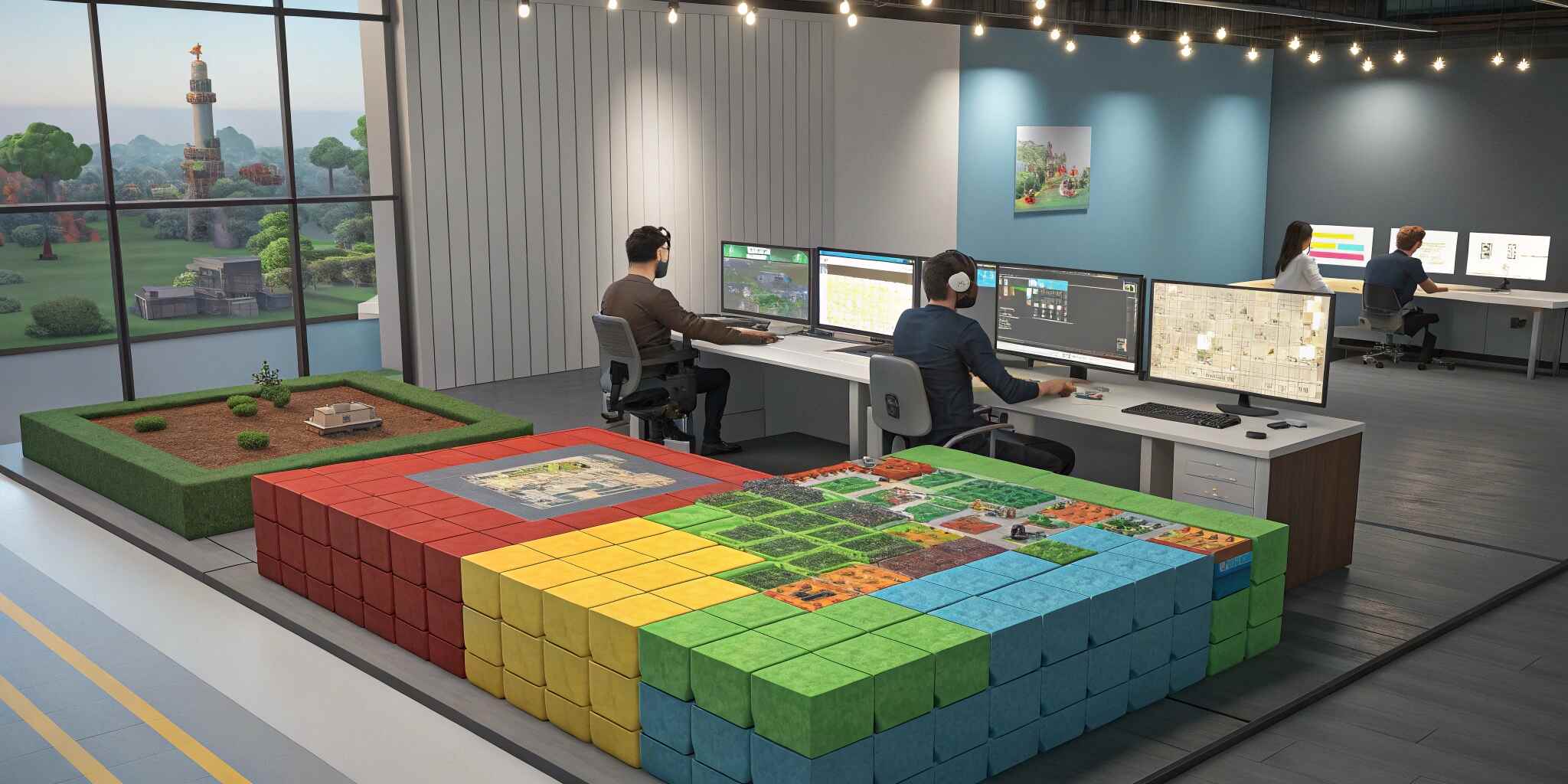
The gaming industry is constantly seeking new ways to build larger, more dynamic, and more immersive environments. While traditional polygon-based rendering has served game development for decades, it begins to struggle when worlds become extremely large, destructible, or procedurally generated. This is where voxel-based rendering emerges as a revolutionary approach, enabling games to generate infinite procedural worlds that players can explore without boundaries or loading screens.
What Are Voxels and Why Do They Matter?
Voxels—short for “volumetric pixels”—represent 3D space as tiny cubes instead of flat polygons. Instead of modeling a surface, voxels store data about volume. This makes them ideal for:
- Fully destructible environments
- Dynamic terrain modification
- Smooth infinite world generation
- Real-time environmental changes
- High-detail volumetric structures
Games like Minecraft, Teardown, and 7 Days to Die have popularized the power of voxels—but modern voxel engines go far beyond block-style rendering.
Today’s techniques use sophisticated data structures and rendering pipelines to achieve photorealistic voxel environments at massive scale.
Infinite Procedural Worlds: How Voxel Engines Make It Possible
Traditional polygon engines load pre-baked terrain or rely on streaming chunks of content. This causes limitations in scale and performance. Voxel engines, however, pair volumetric data with procedural algorithms to generate landscapes endlessly in any direction.
Key technologies powering infinite voxel worlds include:
1. Procedural Noise Functions
Functions like Perlin Noise, Simplex Noise, Domain Warp, and FBM generate:
- Terrain heightmaps
- Caves
- Mountains
- Biomes
- Rivers and erosion
These algorithms can produce unique terrain each time without storing massive datasets.
2. Chunk-Based World Streaming
The world is divided into voxel chunks that load and unload dynamically based on player location. This ensures infinite extension without memory overload.
3. Real-Time Meshing
Raw voxel data is too heavy to render directly, so voxel engines generate polygon meshes on the fly:
- Marching Cubes
- Dual Contouring
- Transvoxel for smooth transitions between LODs
Real-time meshing allows smooth surfaces, detailed caves, and seamless terrain transitions.
Sparse Voxel Octrees (SVO): The Secret to High Performance
One of the biggest breakthroughs in voxel rendering is the Sparse Voxel Octree.
An octree recursively divides space into smaller cubes only where needed. Sparse storage ensures that:
- Empty space uses zero memory
- Detail is stored only where necessary
- Rendering is extremely optimized
SVOs enable:
- Real-time global illumination
- Massive draw distances
- Efficient LOD systems
- High-resolution voxel detail
This is how engines like Atomontage, NanoVoxel, and VXGI achieve cutting-edge performance.
Level of Detail (LOD): Smooth Performance at Any Scale
Infinite worlds require dynamic levels of detail. Voxel systems adapt resolution based on distance:
- High-detail voxels near the player
- Low-detail volumes far away
- Seamless transitions using Transvoxel or dual contouring
This reduces rendering load while keeping visuals sharp.
Applications in Modern Game Development
Voxel rendering is no longer just for blocky sandbox games. It powers:
- Open-world survival games
- Fully destructible shooters
- Realistic terrain simulation
- Infinite exploration games
- Sandbox creation platforms
- Volumetric fog and clouds
- Physics-driven environments
Developers are increasingly exploring voxel technologies for next-gen immersive experiences.
Challenges and Future Innovations
Despite its advantages, voxel rendering faces challenges:
- Heavy memory usage if poorly optimized
- Real-time meshing cost
- Complex lighting models
- GPU requirements
However, ongoing advancements—like GPU-driven voxel pipelines, hybrid voxel-polygon engines, neural compression, and RTX-accelerated voxel GI—are pushing the boundaries further.
Conclusion
Voxel-based rendering is becoming one of the most powerful techniques for creating infinite procedural worlds. With technologies like SVOs, adaptive LOD, real-time meshing, and advanced procedural algorithms, developers can build vast, immersive, and endlessly explorable game environments that were previously unimaginable.